The real cost stack behind private-label frozen meal production
A frozen meal co-packer's quote prices the pouch and the fill line. It rarely prices the freezer, the refrigeration load or the shelf-life clock a broken cold chain starts the moment the truck leaves the dock — and that is usually where the margin goes.
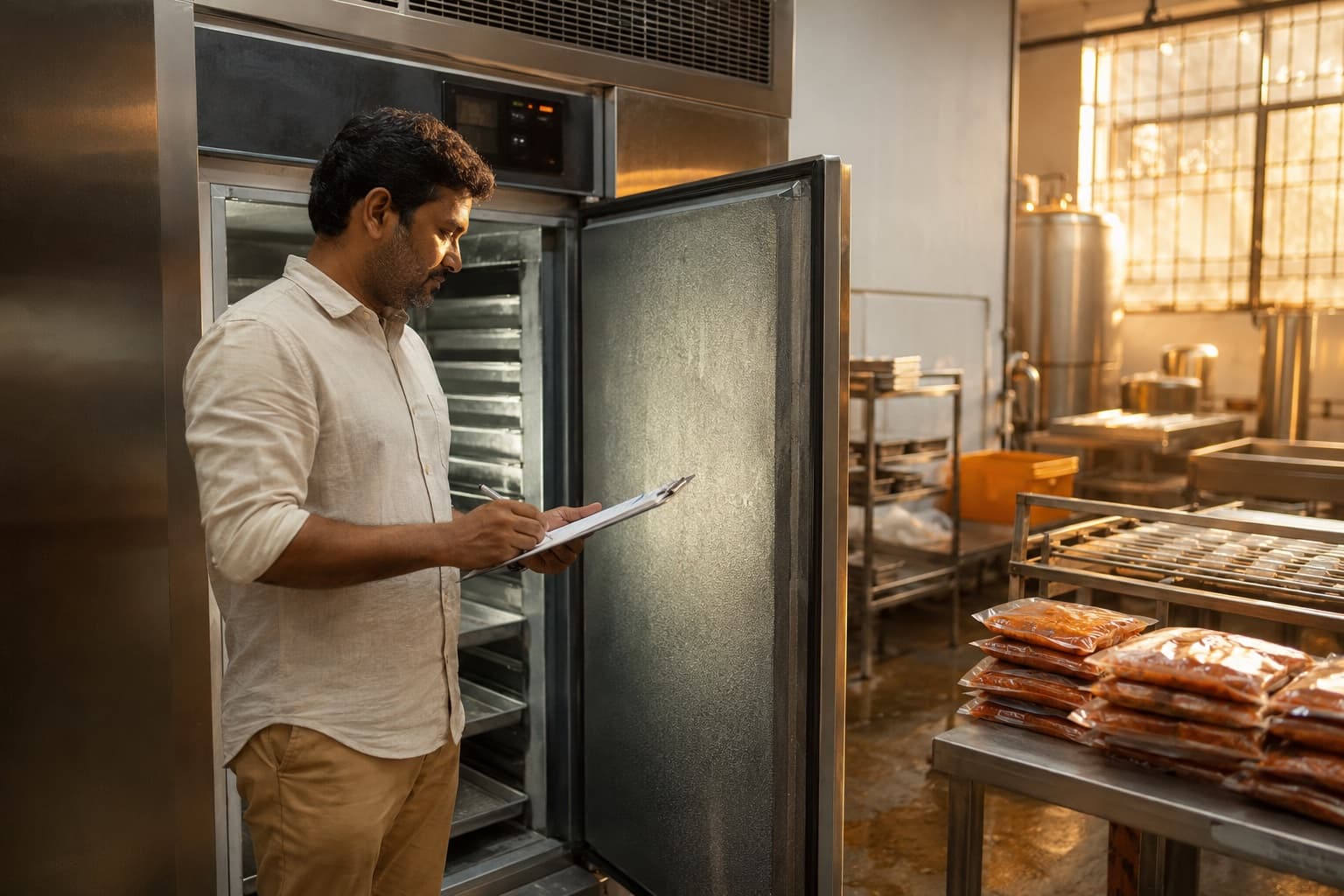
Two co-packer quotes land for the same private-label frozen paratha line. Quote A is eight rupees a kilo cheaper than Quote B. A founder comparing them on that one number alone is comparing the wrong thing, because neither quote says how the product is frozen, how long the cold chain has to hold before it reaches a shelf, or what happens to the batch the day a reefer truck runs warm for four hours on the highway. Those three questions decide more of the landed cost than the per-kilo rate does.
Frozen private label looks like the same exercise as any other private-label decision — license a formula, pick a co-packer, sign an MOQ. It is not. Freezing adds an entire capital and logistics stack that a retort or ambient product never touches, and almost none of that stack is visible on the quote.
Where most of the operating cost actually sits
Across frozen food manufacturing generally, raw material is 65–75 percent of operating cost and utilities — overwhelmingly refrigeration — run another 15–20 percent, leaving a gross margin band of roughly 30–40 percent before the freezing and cold-chain-specific costs are even separated out. That utilities line is the one a fresh-format or shelf-stable private-label product doesn't carry at anything like the same weight, because refrigeration runs continuously, whether or not a production shift is on the floor.
The reason freezing is capital-hungry rather than just electricity-hungry is the equipment doing the work. An IQF (individually quick frozen) tunnel is commonly sized against a refrigeration load in the order of 150 kW per tonne of product per hour — a number that tells you why a co-packer with a modern IQF line quotes differently from one running an older blast freezer, and why that difference in equipment is baked into your MOQ long before it shows up as a per-kilo price.
IQF versus blast freezing is a trade-off you inherit
IQF freezes each piece separately and fast, which limits the ice crystal formation that tears cell walls and dumps moisture on thaw — the mechanism behind mushy vegetables and watery gravy once a frozen product is reheated. Blast freezing is cheaper to install and run but freezes more slowly and in bulk, which means larger ice crystals, more drip loss, and more product that fails a quality check before it ever reaches a customer.
The freezing method isn't a spec you choose after signing the co-packer — it's a spec the co-packer already chose when they built the plant, and you inherit it.
A founder evaluating two quotes should ask which freezing technology is on the line, not assume the cheaper quote used the same one. The gap in upfront capital between blast and IQF equipment is exactly why the cheaper quote can afford to be cheaper — and exactly why it may cost more in wastage and returned stock once the product is actually moving through a real supply chain.
The cold chain doesn't stop at the factory gate
A retort product that leaves the factory is done being fragile. A frozen product is not — it stays exposed to the same cold-chain risk at every handoff: reefer transport, distributor cold storage, the retailer's freezer, and however many minutes it sits on a loading dock in between. Thaw loss alone — the product that never reaches a plate because of drip, over-thaw or a temperature excursion — typically runs 4–8 percent of what was paid for, and that is the well-behaved case where the chain never actually breaks.
Run the same months-of-stock model that applies to any private-label MOQ — MOQ divided by realistic monthly sell-through — but size the tolerance to a frozen product's real constraint. A retort product's shelf life gives you months of buffer if a distributor is slow to move stock. A frozen product's buffer is the freezer capacity at every link in the chain, and a cold-chain lapse anywhere in that path can write off the batch regardless of how much shelf life was left on paper. An MOQ that looked survivable against a retort shelf-life clock can be the wrong number entirely against a frozen one.
Where a retort format escapes the stack
None of this is an argument that frozen is the wrong call — for products where texture genuinely depends on the fresh-frozen state, it is often the only right one. But for base gravies, marinated proteins and prepared dishes where what matters is flavour and consistency rather than a fresh-frozen bite, a retort-stable format sidesteps the entire stack above: no IQF or blast capex to inherit, no refrigeration line eating 15–20 percent of OpEx, no cold chain to survive between factory and shelf.
Kaflur manufactures private-label retort gravies, marinades and dehydrates precisely because that format removes the freezing and cold-chain economics from a brand's cost sheet without asking them to compromise on the dish. If you are pricing a frozen meal line and the quote doesn't mention the freezing method or the cold-chain assumptions behind it, that is worth a conversation before the MOQ is signed — including whether the product needs to be frozen at all.