
Onion price swings shouldn't set your menu price — the case for a dehydrated hedge
Onion is the one ingredient in nearly every Indian menu, and its price is set by export policy more than by your kitchen's demand. Here is how to take that line item off the news cycle.
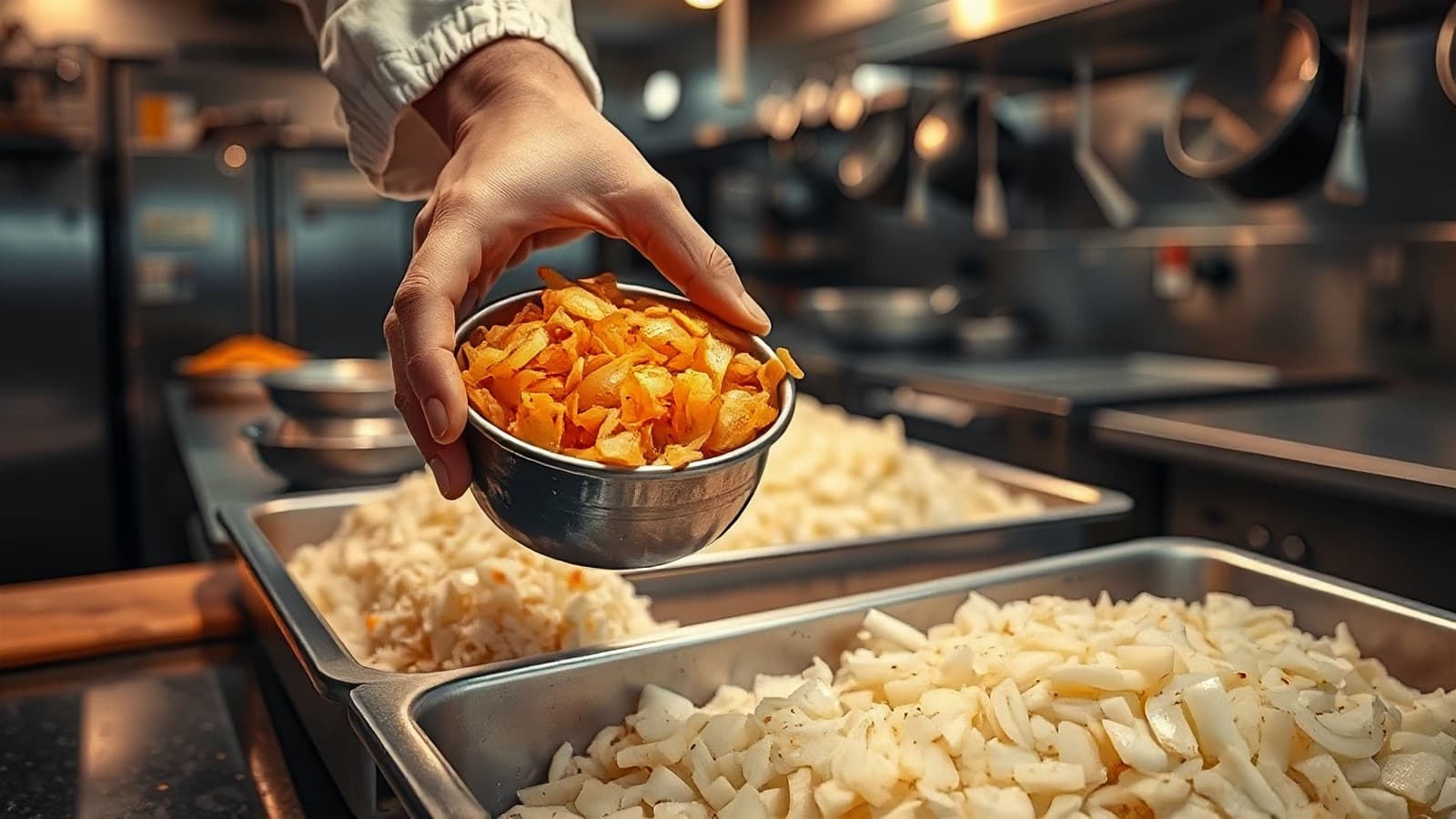
Every gravy, dal and biryani base in an Indian kitchen starts with onion, and no line on the food-cost sheet moves as violently. India banned onion exports in December 2023, let the ban lapse in March 2024, then re-imposed a round of export curbs that November, before finally withdrawing a 20 percent export duty on 1 April 2025 — sixteen months of policy whiplash on a single ingredient. Retail onion prices hit a five-year high in 2024. None of that had anything to do with how many covers your kitchen did that quarter, and all of it landed on your food cost anyway.
That is the actual problem: the ingredient at the base of almost every dish is priced by a market your kitchen has no view into and no influence over. A chef who repriced the menu last month based on that week's onion rate was pricing on noise, not signal.
What you are actually buying when you buy fresh onion
The invoice says price per kilo, but that is not the unit your kitchen consumes. What lands on a plate is peeled, trimmed, chopped or browned onion, and a chunk of the kilo you paid for never gets there. Peeling and root loss, over-ordering against a spoilage curve, cold storage for a vegetable that does not actually need refrigeration to hold — all of it sits on top of the quoted rate, and none of it shows up on the same line as the purchase price.
Run the model with your own numbers rather than an industry average, because trim loss and spoilage vary by supplier, storage and season. The point is not a specific percentage — it is that the real cost of fresh onion is always higher than the invoice, and that gap widens precisely when the market is volatile, because kitchens over-order to buffer against a price spike and then eat the spoilage on the buffer.
The case for locking the cost, not chasing it
A dehydrated onion converts at roughly seven kilograms of fresh onion to one kilogram of dried product, at around 8 percent moisture, and holds for up to 24 months without refrigeration. Rehydration runs close to one part dried to four parts water by weight, which gets you back to a usable base for gravies, stocks and stuffings. None of that is a marginal saving on paper — it is a different kind of purchase entirely. You are not buying a perishable commodity that a policy announcement can reprice overnight. You are buying a shelf-stable input you can contract on a season, at a rate you set once and hold.
Fried onion — birista — makes the same case from the garnish side. Getting a consistent golden colour and crunch out of fresh onion at volume is a labour-intensive, oil-hungry process with real batch-to-batch variance; a central kitchen doing hundreds of biryani portions a day cannot afford a chef re-learning the fry every shift. Pre-fried birista gives you the same finish, the same weight per portion, every time, at a cost you already know before the dish is plated.
The kitchens hurt worst by onion price spikes are the ones that never separated the ingredient's flavour role from its physical form.
None of this argues for dropping fresh onion everywhere. Where a dish's identity depends on the specific texture of fresh-cut onion — a salad, a raw garnish, a chutney eaten within the hour — dehydrated is the wrong substitution and no amount of cost logic should move you off it. The argument is narrower and more useful than that: for the base-gravy layer, the bulk stock layer, and the fry-garnish layer — the volume uses where onion is an input, not the point of the dish — a dehydrated form takes the ingredient off the news cycle without changing what the diner tastes.
Sizing the hedge
Treat this the way you would size any hedge: not all-or-nothing, but proportional to your exposure. Look at what share of your onion spend sits in base gravies, stocks and fried garnish versus fresh-forward preparations, and move that share onto a fixed-cost dehydrated contract first. That is the portion of your P&L that was moving with export policy for no reason connected to your operations, and it is the portion you can remove from that exposure without touching a single recipe a guest would notice.
Kaflur dehydrates onion — chopped, sliced, powdered, or as birista — to a controlled moisture and grind specification, in formats from oxygen-flushed retail pouches to bulk drums and jumbo bags for manufacturing lines. If your onion line has been the surprise on every monthly food-cost review, it is worth a conversation about how much of it you could fix at a rate you choose.