
Retort vs Frozen — the real kitchen economics of a base gravy
Frozen gravies look cheaper per kilo until you cost the cold chain, the thaw loss and the labour. Here's the full-stack maths for a high-volume kitchen.
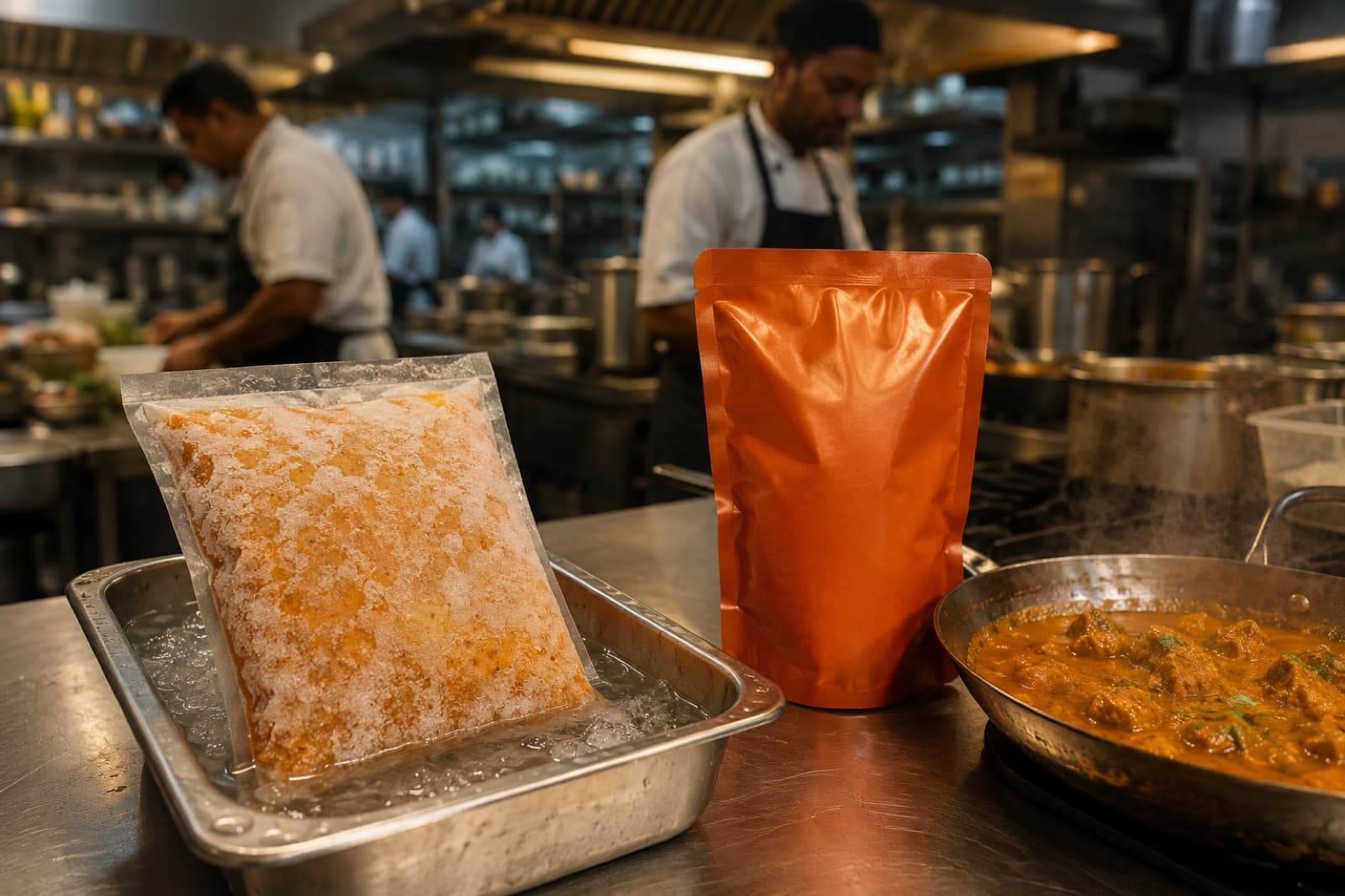
Every kitchen that has scaled past a few hundred covers a day eventually runs the same numbers: should the base gravies be made in-house, bought frozen, or bought retort-stable? The answer that shows up on a supplier quote — price per kilogram — is almost never the answer that shows up on the P&L.
Here is the maths we walk HoReCa buyers through.
The sticker price lies by omission
A frozen butter gravy might land at a lower rupee-per-kilo than its retort equivalent. But frozen carries three costs that never appear on the invoice:
- Cold chain. Freezer space is the most expensive real estate in any kitchen, priced in both capex and the electricity bill that runs 24 hours a day whether or not you open the door.
- Thaw loss. Between drip, over-thaw and the portions that get discarded after a temperature excursion, 4–8% of what you paid for never reaches a plate.
- Labour and lead time. Someone has to plan the thaw a day ahead. A missed thaw is a menu item you can't serve at peak.
Retort-stable gravy removes all three. It sits on a dry shelf at ambient temperature, opens to full yield, and is ready the moment a ticket comes in.
A worked example
Take a cloud kitchen running 1,000 portions of gravy-based dishes a day, at roughly 150 g of base per portion — about 150 kg of gravy daily.
The question isn't "which is cheaper per kilo." It's "what does a served portion actually cost me, all-in."
When you load the frozen number with cold-chain energy, thaw loss and the labour to manage it, the effective cost of a served portion routinely crosses the retort price — before you've accounted for the freezer you had to buy and the peak-hour dishes you couldn't serve because the thaw ran short.
Where retort wins, and where it doesn't
Retort isn't universally correct. For a low-volume, high-touch fine-dining kitchen making twelve covers of a bespoke sauce, in-house wins on flavour control and there's no scale to amortise. Retort earns its place the moment consistency at volume and zero cold-chain matter more than bespoke tweaking — which is to say, most kitchens past a certain size.
The Kaflur gravies range is built for exactly that crossover point: retort-crafted regional bases that hold twelve months at ambient, open to full yield, and taste the same on every shift.
If you're weighing this decision for your own kitchen, the honest way to settle it is to run your covers, your energy tariff and your labour cost through the full-stack model — not the sticker price. That's a conversation we're happy to have.