
What a manufacturer needs from you before they can quote
Most enquiries arrive with a recipe and a target price. Neither is enough to price a production run, and a manufacturer who quotes anyway is guessing at your expense. Here is the brief that gets a real number back.
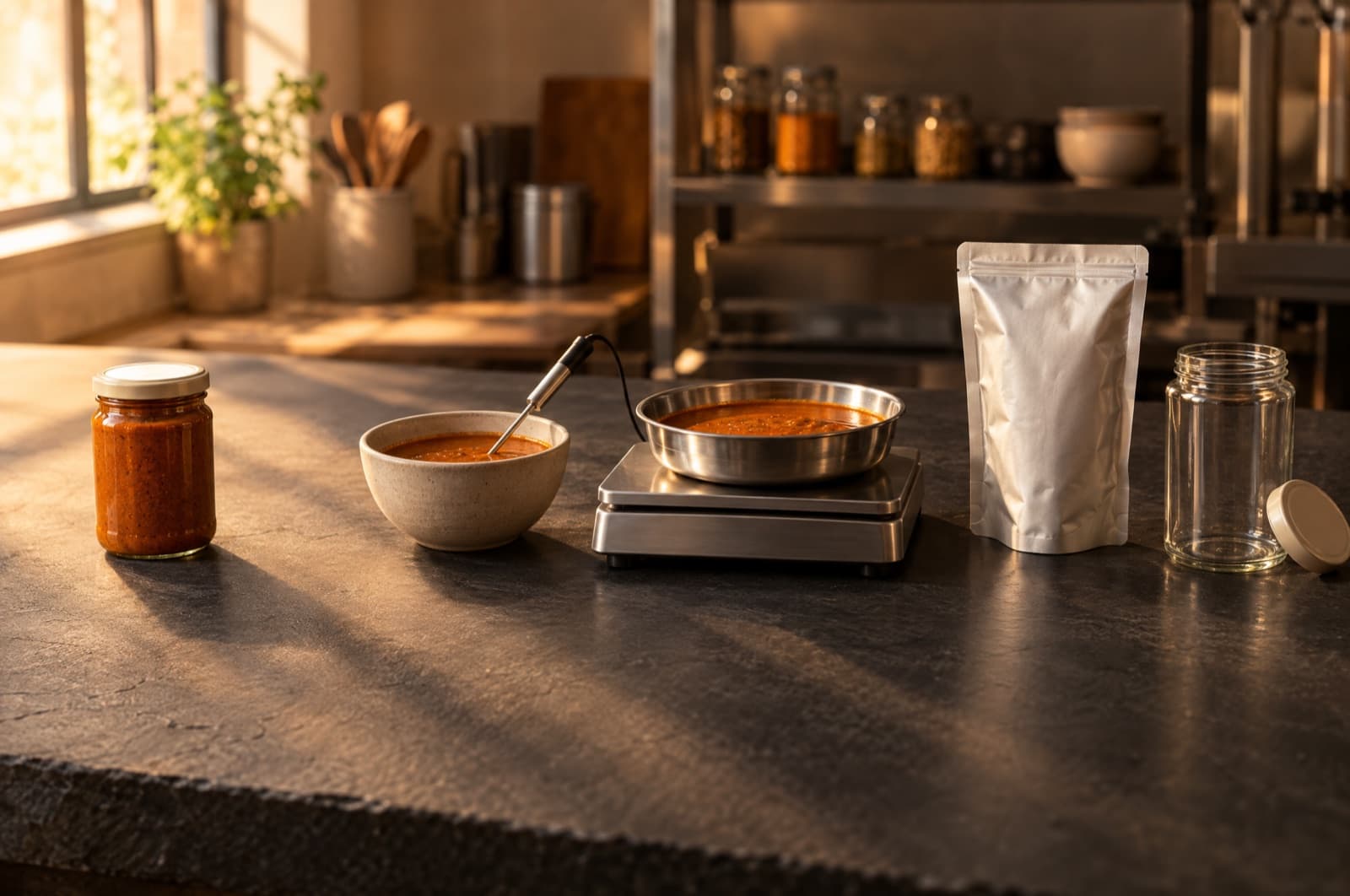
The enquiry arrives with a paragraph about the brand, a recipe pasted underneath, and one question: what would this cost per unit?
It is a fair question. It is also, as written, unanswerable — and the manufacturers who answer it anyway are the ones to be most careful of. A quote is not a lookup against a price list. It is the output of a short technical review, and until that review has something to work with, any number produced is a placeholder that will move later. Usually after you have printed a price on a pack.
The gap is rarely that the founder is unprepared. It is that nobody has told them which six things actually set the number.
A recipe is not a formula
The difference between the two is scalability.
A recipe is a set of instructions for a cook. One large onion, a handful of curry leaves, sauté until golden. Every quantity in it is relative to a pan, and every instruction assumes a person standing over it making judgements.
A formula is a percentage composition. Every ingredient is expressed as a proportion of batch weight, which means it scales to two kilograms or two tonnes without anyone re-deriving it. That single change in format is what allows a manufacturer to cost the materials, model the yield and plan a run.
Processing steps need the same translation. "Sauté until golden" has to become a vessel, a temperature, a hold time and a shear rate — because the equipment has no judgement and the outcome has to be identical on the fortieth batch. A manufacturer can do that translation for you, and a good one will. But the work is real, it takes time, and it belongs in the quote rather than hidden underneath it.
This is also why a brand moving between manufacturers is often an easier proposition than a brand moving out of a kitchen. The translation has already happened, and both sides know what the product does at scale.
The kill step is chosen by the product, not by preference
Nearly every shelf-stable food needs a step that makes it safe to sit at ambient temperature. Which step, though, is not a choice the brand gets to make on aesthetic grounds. It is decided by the product's own chemistry and the pack it goes into.
Acidity is the first fork. Above pH 4.6, the acid does part of the preservation work, and hot filling becomes viable — which opens up glass. Below it, the product has to be processed to commercial sterility, which in practice means retort, which for most gravies means a pouch.
Viscosity, particulate size and fill weight then decide how long the heat takes to reach the slowest-heating point in the pack, and that time is a direct cost. A thick gravy with visible vegetable pieces and a thin sauce of identical composition are not the same product to a production planner, even though they read the same on a cost sheet.
Until a manufacturer knows the pH and the intended pack format, it does not know which line your product runs on. Which line it runs on is most of the cost.
A quote built from a recipe and a target price is a guess with a decimal point in it.
Volume is two numbers, and most briefs contain neither
Manufacturers think about volume in two separate ways, and founders usually supply a third that answers neither.
The production-run minimum is roughly what a line makes in a full shift when it is properly utilised. It exists because the setup, the changeover and the clean-down cost the same whether the run is short or long, so a short run loads all of that onto very few kilograms.
The annual volume is a different question entirely: will this account come back often enough to be worth carrying? A brand ordering once a year and a brand ordering monthly present identical annual tonnage and completely different propositions, because one of them means twelve changeovers and twelve scheduling slots.
The order pattern matters as much as the total. Twelve tonnes in a single run and one tonne every month are the same year and not the same cost — the second carries more changeovers, the first carries more warehousing and more of your working capital sitting in finished stock.
One practical note that saves a round of confusion: manufacturers generally quote and invoice in cases, not units. Fill weight, units per case and the pallet pattern are part of the brief, not administrative detail to settle afterwards.
The brief that gets a real number back
Six things, and a seventh that matters more than founders expect.
The formula as percentages, with any ingredient you intend to source yourself marked as such. The process steps as close to production language as you can manage — or an honest statement that you need help translating them. The pack format and fill weight, with units per case and the markets it will be sold into. The shelf-life requirement, and whether the product sits ambient, chilled or frozen. Volume in both forms, per run and per year, with the order pattern. Your target cost, stated as a target rather than a constraint, so the conversation can be about what is achievable at it.
The seventh is what you do not yet know. A brief that says "we have not measured pH" or "we have not decided between two pack sizes" is more useful than one that guesses, because the guess has to be unwound later and the gap can be closed in a week.
If most of that list is still open, that is not a failure — it means the first piece of work is product development rather than production, and it should be scoped and priced as development. A manufacturer that skips that distinction to win the enquiry is not doing you a favour.
At Kaflur, the brief is where every Build engagement starts, and the questions above are close to the ones we ask in the first conversation — including which ones we can answer on your behalf. If you have a product that works in a kitchen and no clear route to making it at volume, that conversation is worth having before the numbers get committed to anything.