What actually sets a co-packer's minimum order quantity
A quote's MOQ line looks like an arbitrary number a manufacturer picked to pad the order. It isn't — it's a changeover cost divided across a batch, and once you can see that arithmetic, you know exactly what is and isn't negotiable.
A founder gets a quote back: 4,000 units minimum. The per-unit price is fine. The MOQ is not — sell-through says 600 units a month, which makes this six-plus months of inventory sitting in a warehouse before the batch has proven anything. The instinct is to treat the number as a negotiating opener, ask for 2,000, and see what the manufacturer says.
That works sometimes, and fails more often than it should, because most founders are negotiating against a number without knowing what generated it. An MOQ is not a policy the plant invented to make life difficult. It is the smallest batch that covers the cost of stopping the line, cleaning it, and setting it up again for your product — divided across enough units that the plant still makes its margin. Once you can see that arithmetic, you know which part of the number is real and which part is padding.
The cost hiding inside "changeover"
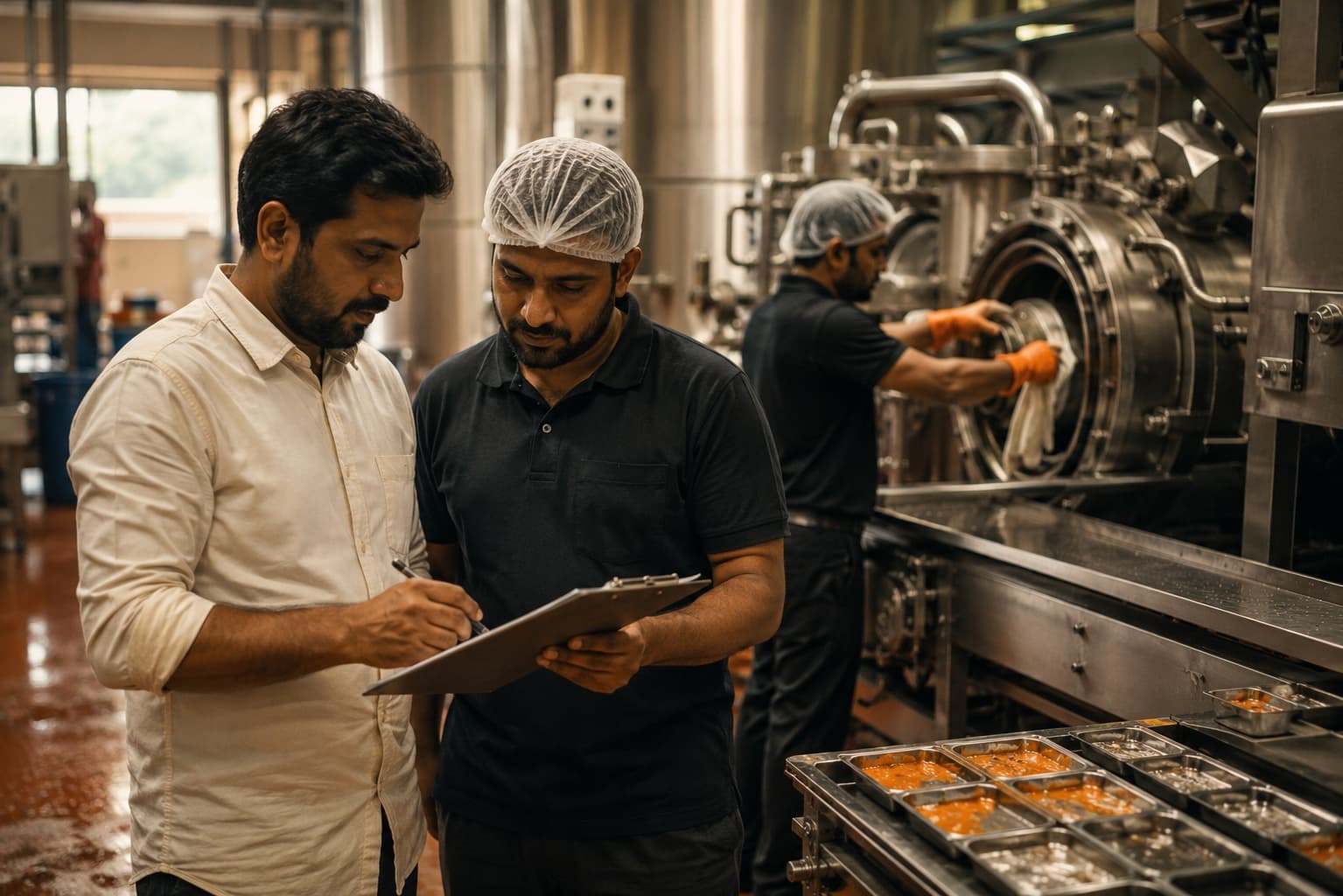
Every time a production line switches from one product to another, it stops earning. Equipment gets torn down, cleaned — often the single most time-consuming step, particularly on lines handling wet gravies or marinades where allergen and flavour carryover matter — reassembled, and run through a first-piece quality check before the plant will call it production again. None of that produces a sellable unit. It is pure cost, and it has to be paid for by the batch that follows it.
A widely cited 2014 survey of US food-manufacturing plant managers put the average changeover at just under an hour, occurring close to five times a day, with idle-line losses running over $2,600 an hour once lost production is priced in. That is a different market and a dated number, not a figure to import into an Indian retort or dehydrate line. What travels is the shape of the model: a plant that has just spent real money and real line-time on a changeover has no reason to accept an order too small to recover it.
The MOQ on your quote is rarely a round number the plant likes. It's the smallest batch that pays for the changeover it just did.
The formula behind the number
Reduced to arithmetic, it looks like this: MOQ ≈ changeover cost ÷ (price − variable cost per unit) × the plant's target margin buffer. Changeover cost is setup labour, cleaning time, and line downtime, all priced at what that hour of the line is worth. The denominator is what each unit actually contributes once raw material, packaging and direct labour are paid — the same contribution-margin logic behind any breakeven calculation, just run from the manufacturer's side of the table instead of yours.
This is a model to build with your own manufacturer's numbers, not a formula to plug India-wide averages into — changeover time on a retort autoclave batch is a different animal from a fryer line, and a plant running three shifts amortises a changeover very differently from one running one. But the shape holds everywhere: a product that requires a long, fussy changeover — multiple allergen flushes, a packaging format the line rarely runs, a spice profile that needs a full clean rather than a rinse — will always carry a higher MOQ than one that slots into a changeover the plant already does routinely, regardless of what either product sells for.
What's actually negotiable
Once changeover cost is the variable driving the number, three levers become visible that "just ask for a lower MOQ" never reaches.
Slot into an existing changeover instead of demanding a dedicated one. A gravy that shares a base masala or a marinade that shares a brine profile with something the plant already runs needs a shorter, cheaper changeover than a genuinely new product — and a shorter changeover supports a smaller MOQ honestly, not as a favour.
Match packaging to what the line already runs. A pouch size or closure the plant has never handled adds its own setup and validation time on top of the product changeover; a format already qualified on the line removes it.
Ask what changeover the plant is quoting against, specifically. A quote that can't answer "how long does this changeover take on your line, and what's driving that" is quoting a rule-of-thumb MOQ, not a costed one — and rule-of-thumb numbers pad more than costed ones do, which is exactly where there is room to negotiate.
Where this changes the conversation
This doesn't replace the sell-through math — divide the MOQ by your realistic monthly volume and you still need that number to be survivable. What it adds is the ability to ask a sharper question before you get to that stage: is this MOQ high because the product genuinely needs a long changeover, or because nobody has tried to shorten one.
Kaflur prices private-label runs against a library of retort gravy and marinade bases precisely so a new formula can share a changeover with something already on the schedule, rather than opening a new one from scratch — which is usually the difference between a 4,000-unit minimum and one a young brand can actually carry. If your current quote can't tell you what its MOQ is paying for, that's worth a conversation before you negotiate the number itself.