
Why a founder's recipe doesn't survive its first production run
A dish that's perfect by hand in the founder's own kitchen routinely comes out different on a production line, not because the crew got it wrong, but because a recipe written in pinches and "until it smells right" was never a specification a stranger could reproduce.
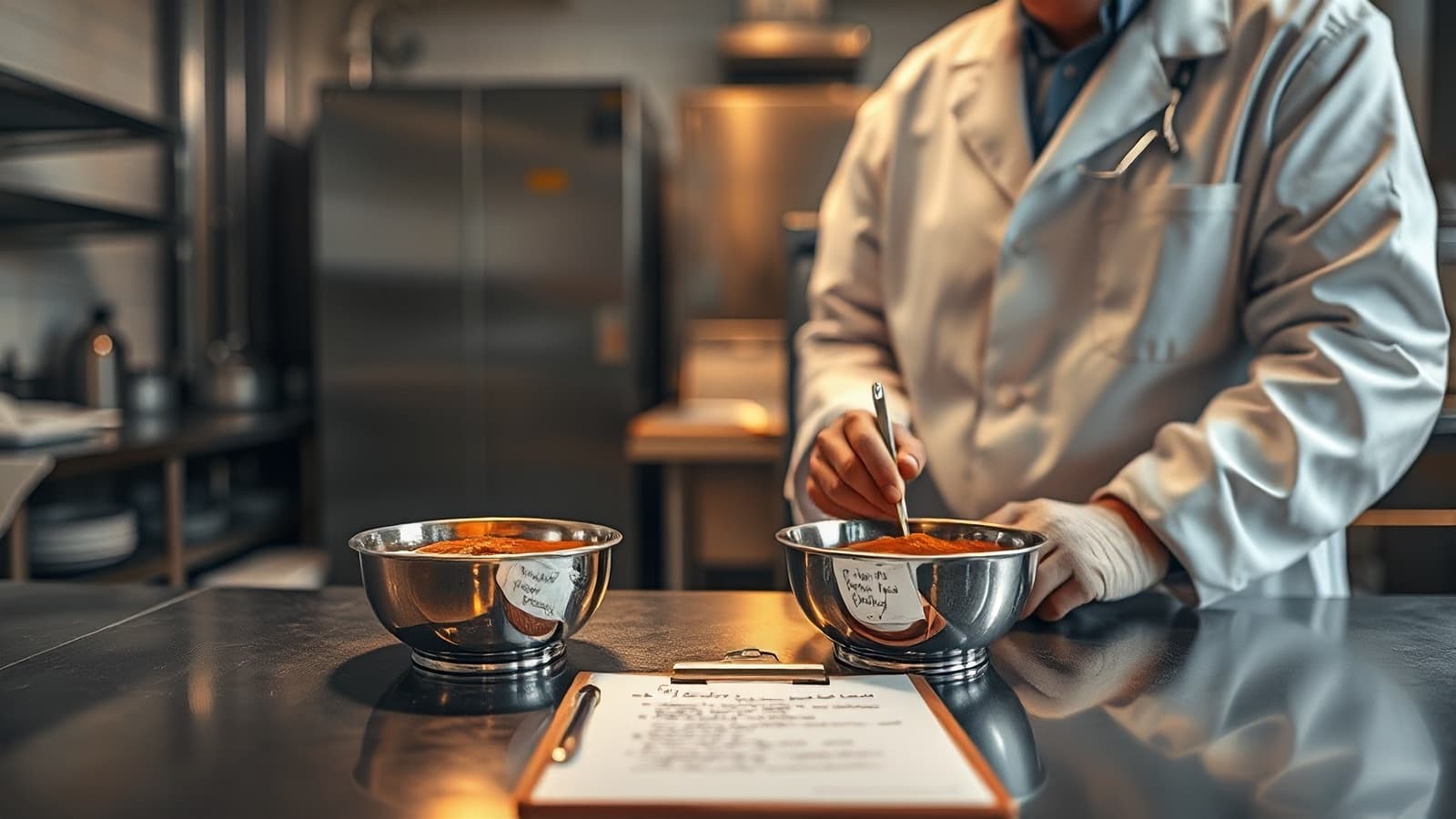
A founder brings a dish to a manufacturer to be scaled up. It's a recipe they've made a hundred times, tested on friends and early customers, tuned until it's exactly right. The manufacturer follows it precisely — same ingredients, same order, same quantities. The first production batch comes back, and the founder tastes it and says: this isn't it. Nobody changed the recipe. What happened is that the recipe was never the whole instruction to begin with.
A recipe is a memory, not a spec
Most recipes that work perfectly in one kitchen are full of instructions that only make sense to the person who wrote them: a pinch of this, sauté until it smells right, cook until the oil separates from the masala. Those aren't vague out of carelessness — they're shorthand for a set of senses the founder has trained over years of making the same dish. A stranger following the same steps in a different kitchen, with a different stove, different batch of chillies and different tap water, has no way to hit the same endpoint, because the endpoint was never written down as something measurable. It was written down as a feeling.
This isn't a hypothetical problem specific to first-time founders. A recent account of Indian regional snack brands scaling nationally found the same failure at real commercial scale: one startup's pepper cashews, a Thoothukudi speciality, couldn't be replicated when production moved elsewhere, because — in the founder's words — "people assume water is water; it isn't." Local water chemistry changes dough behaviour, fermentation and texture extraction in ways a written recipe never captures. The same account notes a Calcutta chanachur that simply couldn't be reproduced once manufacturing moved to Jaipur. These are not small operations getting it wrong. They are the exact failure mode a founder's recipe runs into on its first production run, just at a bigger scale.
Turning "tastes right" into a number
The fix isn't a better-written recipe. It's translating the founder's sensory target into parameters a lab and a production crew can actually measure and hit, batch after batch, regardless of who's on shift.
Chilli heat is a clean example of what that translation looks like in practice. "Medium spicy" means nothing on a production floor, because chilli heat varies by season, by plant, and even between pods on the same plant — water-stressed crops run hotter, and one harvest's mild batch can be another harvest's fiery one. The industry answer is to stop trusting a supplier's word for it and measure instead: modern testing uses HPLC to quantify capsaicin in parts per million, then converts that to Scoville Heat Units by a fixed formula (SHU = ppm × 15). A "medium spicy" gravy stops being a feeling and becomes a target range on a certificate of analysis, checked against every incoming batch of chilli rather than assumed from the last one.
The same logic applies wherever a recipe currently depends on a cook's judgement — viscosity that "should coat the spoon," a marinade's tang that's "about right," a dip that's "not too runny." Each of those has a measurable proxy — viscosity in centipoise, acidity as titratable acid or pH, Brix for sweetness — and a founder's product isn't reproducible at scale until those proxies are pinned to numbers, sourced against a documented ingredient specification, not re-judged by feel on every batch.
Consistency is rounds, not a single tasting
Even with numbers in hand, one good batch doesn't prove a formulation is locked. The standard way food scientists check whether a new batch genuinely matches a reference is the triangle test: panellists are given three coded samples, two identical and one different, and asked to pick the odd one out. It's used specifically whenever an ingredient, supplier, or process changes — which is exactly the situation a founder's recipe is in in the early rounds of scale-up. Because panellist fatigue sets in fast, a session usually caps out at around six samples, so getting a formulation right is a sequence of small, disciplined rounds against the founder's own reference sample, not one long tasting where everything is decided at once.
A recipe only one person can execute isn't a product yet — it's a memory with ingredients attached.
This is also why the players who scale regional food successfully treat it as ongoing, structured work rather than a one-time handover. MTR Foods runs an in-house R&D centre where chefs work directly with home cooks and food historians, building a repository that now runs past 4,000 recipes — not to standardise everything into sameness, but to know precisely what has to be measured and held constant to keep a dish authentic once it leaves a home kitchen for a factory floor.
Where this fits into building a food brand
This is the actual work behind what Kaflur calls product development: taking a founder's taste memory or a benchmark sample and formulating it against measurable specifications — sourcing, sensory tuning, cost and process engineering — testing each round against the founder's own reference until the two are indistinguishable, before that formulation ever reaches a commercial production run. A recipe that only works in one kitchen isn't a failure of the recipe. It's a sign the translation step hasn't happened yet.
If you've watched a dish that was perfect in your own kitchen come back different from a trial run, that's usually where the gap sits — and it's worth a conversation about what would need to be measured to close it.