
Why a gravy separates in the bain-marie before service ends, and the batch never changed
A masala gravy that leaves the kitchen glossy and unified can turn oily and thin by the end of a lunch rush — not because anyone changed the recipe, but because the oil-in-water emulsion holding it together comes apart, droplet by droplet, under hours of gentle heat.
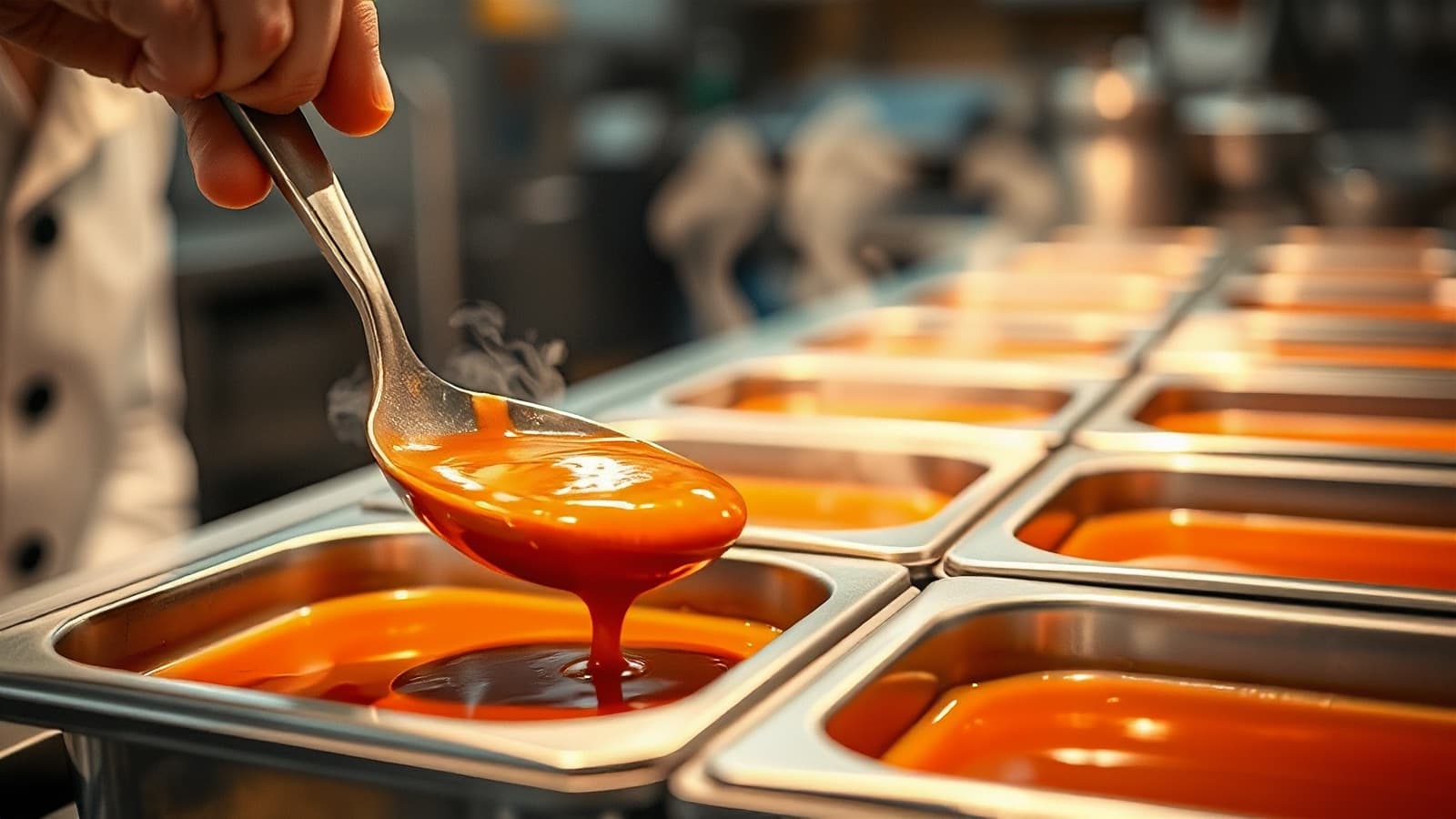
A cloud kitchen fills a bain-marie insert with butter chicken gravy at the start of lunch service. The first plate at 12:15pm looks the way it's supposed to: glossy, deep orange-red, the oil sheen sitting tight against the masala. By 2:30pm, the same pot has a visible slick of orange oil pooled on top, and what's left underneath looks thinner and paler than it did two hours earlier. The kitchen manager assumes something changed — a different batch, a heavier hand with water at the pass — and pulls the log to check. Nothing changed. The gravy that broke by 2:30pm wasn't a different gravy from the one that looked right at noon. It's the same batch, and on the day it was formulated, it was already going to do this.
Hot-holding does what it's meant to — and something else besides
A bain-marie exists to solve one problem: keep cooked food out of the temperature band where bacteria multiply, typically holding it somewhere between 60°C and 90°C for however long a service runs — commonly two to four hours on a busy shift, sometimes longer. A well-run bain-marie does that job reliably. What it also does, whether anyone designed for it or not, is hold an emulsion at close to the temperature and for close to the duration that makes it least stable.
A tempered masala gravy is an emulsion whether or not anyone in the kitchen thinks of it as one — oil worked into an onion-tomato-spice base through frying and reduction, dispersed as small droplets through a watery continuous phase. Straight off the flame, those droplets are small and evenly spread, which is what gives a finished gravy its glossy, unified look. Whether it stays that way over the following hours isn't guaranteed by the recipe. It's a property of how the emulsion was built, and it's the part that a long hold under gentle heat puts under the most strain.
Why the oil finds its way back out
Research on oil-in-water emulsions held at temperatures between 20°C and 70°C — squarely the bain-marie range — has found that droplet coalescence frequency rises with temperature: the warmer the continuous phase, the more often two oil droplets that collide merge into one instead of bouncing apart. At any single moment it's a slow process. What a bain-marie supplies is exactly what coalescence needs to compound — hours rather than minutes, at a temperature well above room heat, with the pot handled, ladled from, and topped up right through service. Enough droplets merge into large enough droplets, and the oil stops behaving like a dispersed emulsion and starts behaving like free oil — which is what's pooling on top of the pot at 2:30pm.
Nothing in that mechanism requires an error at the pass. It requires time and heat, which are the entire point of a bain-marie. A four-hour hold is well inside what catering-equipment guidance treats as a normal safe holding window — which means a kitchen running a long lunch or dinner service is, by design, giving an unstabilised gravy exactly the conditions it needs to break before the last plate goes out.
An emulsion that looks perfect leaving the kitchen can still be built to fail by the second hour of a bain-marie, because nobody engineered it to survive the hold.
This is a different clock to shelf life
It's tempting to file this next to a retort dip separating in its pouch weeks after packing — both end in a layer of free liquid sitting on top of something that used to be uniform. But the two run on different clocks and different mechanisms, and testing for one doesn't cover the other. A pouch on a shelf cools once and sits still for weeks; what threatens it is starch retrogradation over that long, undisturbed timeline. A gravy in a bain-marie is reheated once, then held warm, stirred, ladled from and topped up for a handful of hours inside a single service; what threatens it is emulsion coalescence compounding fast, under continuous heat and handling, inside a much shorter window. A stabiliser system built to survive a shelf doesn't automatically survive a service line, and the reverse holds too — each has to be tested against the conditions it will actually sit in, not the conditions the other product sits in.
That test is simple to run and rarely gets run before a gravy reaches a kitchen: hold a batch at bain-marie temperature for the full length of a real service — three or four hours — stirring on whatever schedule the kitchen actually uses, and check for oil separation at the one-, two- and three-hour marks, not only at time zero. A gravy that passes a same-day tasting can still be one that was always going to fail two hours into someone else's lunch rush.
This is why Kaflur tests a gravy base against the hold conditions it will actually meet in a client's kitchen — bain-marie or steam table, real service hours, real stirring — not only against how it looks the moment it's plated in a trial run. If a gravy or sauce you're currently running turns oily or thin partway through service, that's usually a formulation question rather than a kitchen error, and it's worth a conversation about what the base was actually built to survive.