
Why a retort pouch doesn't need a fridge or a preservative
A shelf-stable gravy sitting on a dry shelf for a year looks, to most chefs and buyers, like it must be loaded with preservatives to survive there. It isn't — the stability comes from a validated heat process, and the number that proves it has a name.
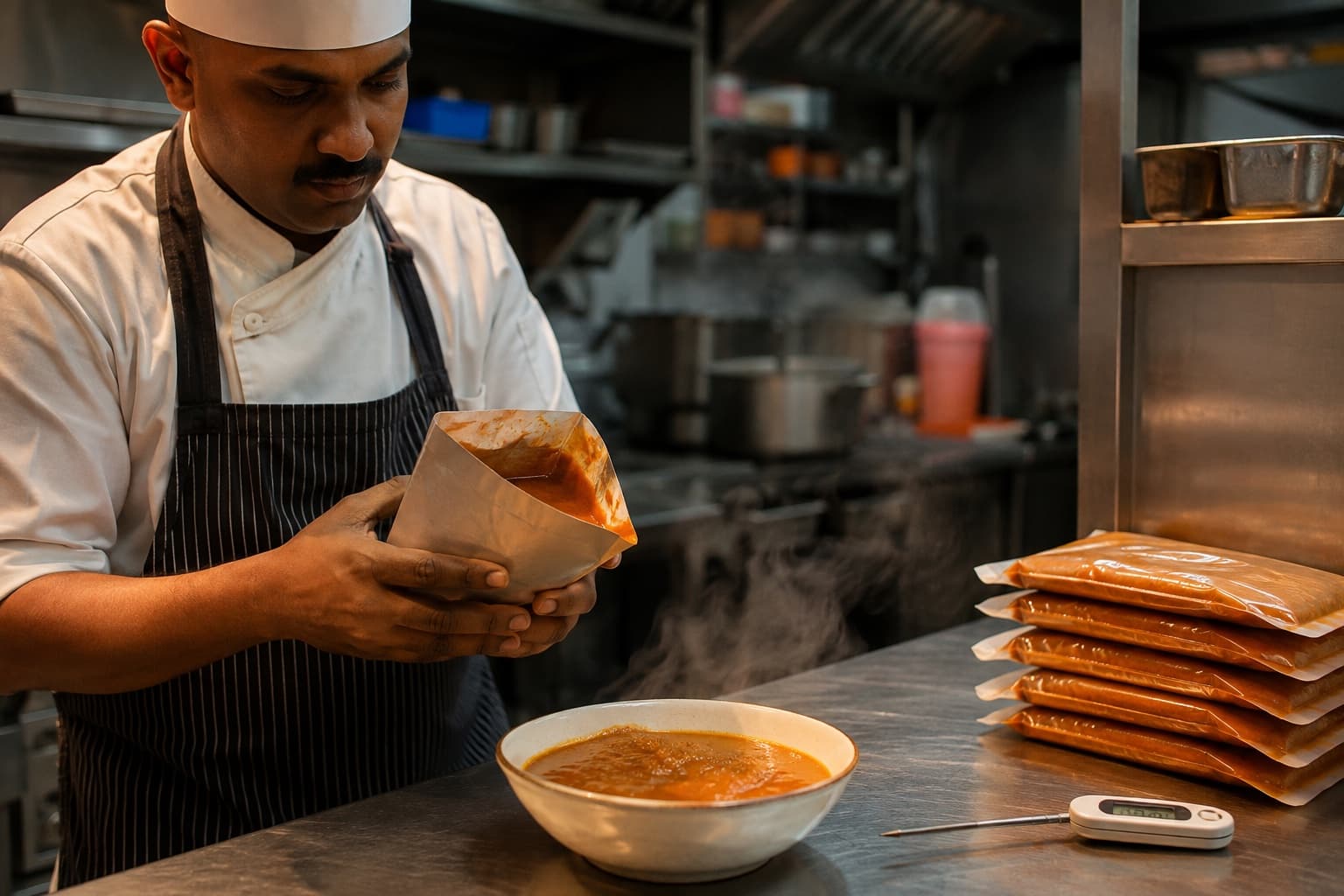
A buyer picks up a retort pouch off a dry shelf, turns it over, and reads a twelve-month best-before date with no refrigeration instruction. The reflex is almost universal: this must be full of preservatives. It's a reasonable guess — nothing else in a normal kitchen sits at room temperature for a year without spoiling — and it's wrong. A retort gravy is shelf-stable because of what was done to it once, in a pressure vessel, for a measured number of minutes. Nothing was added to keep it that way afterwards.
Commercial sterility is a process, not an ingredient
Retort processing seals food into its pouch first, then sterilises the sealed pouch as a unit — under heat and pressure, typically in the range of 115–121°C at roughly 15–20 psi above atmospheric pressure. That combination does two jobs at once: it destroys the organisms that would spoil the product or make it unsafe, and the hermetic seal means nothing can recontaminate it afterwards. There is no cold chain to break and no exposed surface for anything to land on. The stability is sealed in at the point of manufacture, not maintained by chemistry sitting in the pouch.
The technical term for what a retort achieves is commercial sterility, not absolute sterility — an important distinction. A genuinely sterile product, with a zero probability of any surviving organism, isn't manufacturable at any practical scale. What the process instead targets is a defined, tiny, and well-established margin of safety against the one organism that matters most for low-acid, shelf-stable food: Clostridium botulinum. The industry's reference figure for this is called a 12D process — a heat treatment calculated to reduce a botulinum spore population by twelve orders of magnitude, to a probability of survival of no more than one in a trillion containers. That's not a marketing claim. It's a food-safety engineering target with decades of published validation behind it.
The number that does the work: F0
The way a retort process is specified and checked is a single figure called the F0 value — the equivalent time, in minutes, at a reference temperature of 121.1°C, that a product's slowest-heating point has actually received. The regulatory floor for low-acid canned and pouched foods is an F0 of 3 minutes, the minimum "botulinum cook" that delivers that 12D reduction. A real production process runs comfortably past that floor, not up against it.
Getting there is a three-stage cycle inside the retort: come-up time, while the retort itself heats to target temperature and pressure; the hold, where the product sits at that temperature for the calculated duration; and come-down time, where cooling water brings it back down before the pouches are removed. None of those three stages is optional, and none of them can be estimated by eye — they're set by a heat-penetration study specific to the product, run with a temperature probe placed at the point inside the pouch that heats slowest, usually the geometric centre of a thick gravy or a curry with large solid pieces. A thin marinade and a dense paneer gravy in the same size pouch do not reach F0 = 3 in the same hold time, because heat has to travel further through the denser one before that coldest point catches up.
The date on the label isn't a guess about how long preservatives will hold out. It's the output of a number that was measured, once, at the coldest point inside the pouch.
Why this changes what "shelf-stable" should mean to a buyer
This is also where the fridge-versus-shelf comparison actually resolves. A frozen or chilled product is safe because the cold chain suppresses microbial growth continuously, from factory to plate — break that chain once, for long enough, and the safety margin is gone with it, even if nothing looks or smells wrong. A validated retort product's safety margin was already spent, permanently, inside the retort. There's no ongoing dependency to fail. That's a materially different risk profile for a HoReCa buyer managing outlets without reliable cold storage, or a brand shipping into markets where a broken cold chain is a real operational risk rather than a hypothetical one — and it's also why retort products in the Indian market, from MTR Foods' shelf-stable range to ITC's Kitchens of India line, have built entire categories on pouches that never touch a compressor.
None of this means every product is a candidate for retort processing, or that a founder can hand over any recipe and expect the same F0 to apply. A pouch's fill weight, solid-to-liquid ratio, particle size and viscosity all change how fast heat reaches the cold spot, which means the heat-penetration study — and the resulting process time — has to be run again whenever any of those change, not assumed from a previous product.
This is the engineering work behind Kaflur's retort line: running the heat-penetration study for a specific formulation and pouch format, setting the F0 that actually clears 12D at the coldest point, and validating the process before it ever goes to commercial production — so what ships is provably shelf-stable rather than shelf-stable by assumption. If you're evaluating whether a recipe belongs in a retort pouch, that's a conversation worth having before the pouch size or fill weight gets locked in.