
Why a shelf-stable dip separates in the pouch, and the recipe never changed
A retort dip that leaves the plant smooth can turn up at the kitchen with a ring of water round the edge — not because anything spoiled, but because the starch that thickened it during processing is quietly falling apart on the shelf.
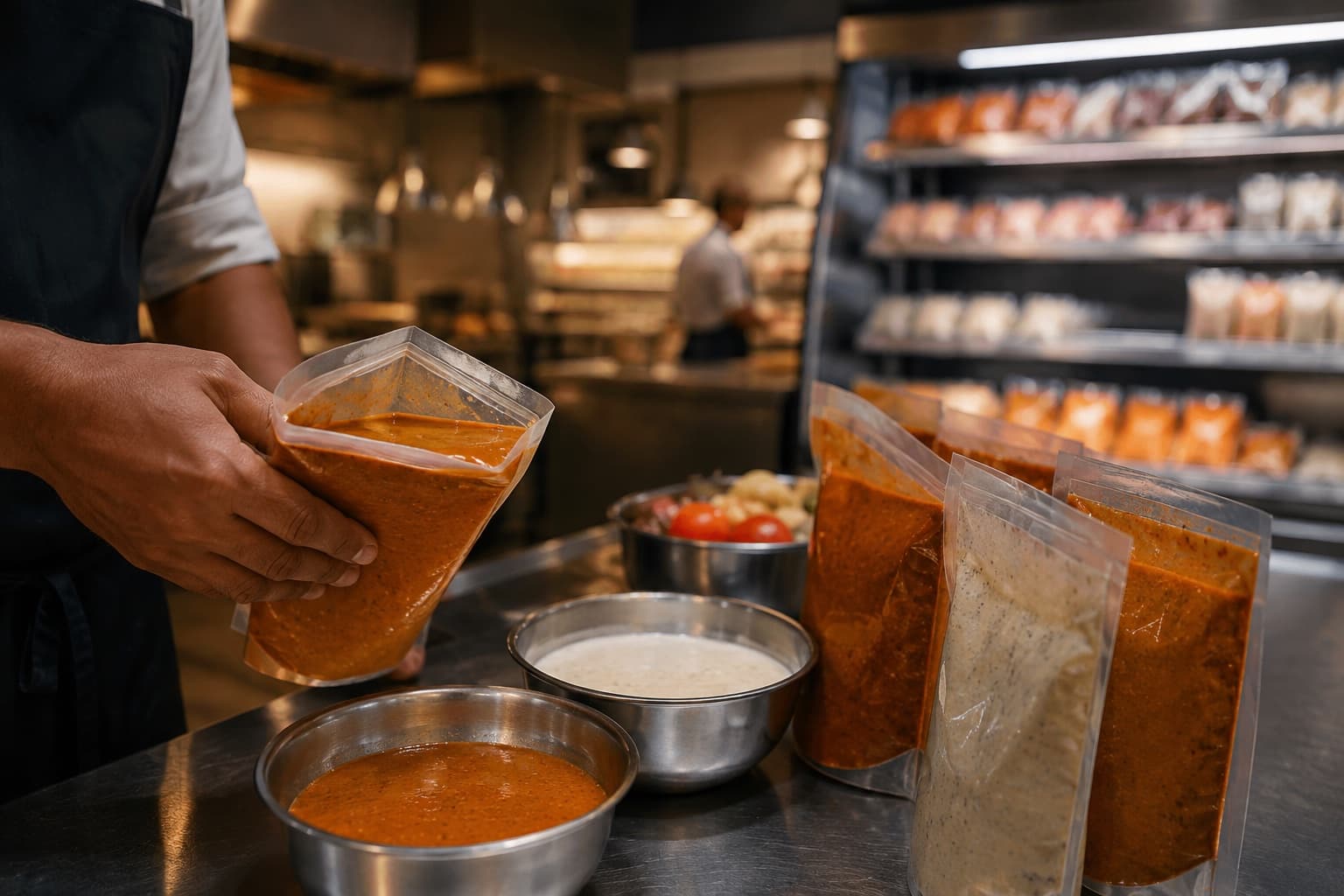
A cloud kitchen orders a case of shelf-stable dip, uses half the batch in week one, and finds the remaining pouches ringed with a thin layer of water when they open them in week four. Nothing smells off. The use-by date is weeks away. The kitchen calls it a leak or a spoilage risk and sends photos to the supplier asking what went wrong at the plant.
Usually, nothing went wrong at the plant. The dip passed every check on the day it was made — right viscosity, right appearance, right taste. What changed is what happens to a starch molecule between the retort cycle and the fourth week on a shelf, and that gap is a formulation decision, not a processing error.
The retort cycle does two things to a dip, not one
Retort processing exists to make a dip shelf-stable without refrigeration: seal it in a pouch or can, then hold it at a high enough temperature for long enough to destroy the organisms that would otherwise spoil it. That heat step is also what gelatinises the starch that gives most dips their body — heat swells the starch granules and lets them absorb water, which is what produces the thick, cling-to-a-chip texture a dip needs straight off the line.
The problem shows up afterwards. Once a gelatinised starch cools and sits, the same molecules that swelled and absorbed water during heating begin to realign and shed that water back out — a well-documented behaviour called retrogradation. It is accompanied by firming, clouding, and water separation, and it is a property of the starch itself, not a sign that anything has gone wrong in storage. A dip can pass its release test on day one and still be built to weep by week four, because the retort cycle that made it shelf-stable is the same cycle that set retrogradation in motion.
Why the starch choice matters more than the recipe
Not every starch retrogrades at the same rate, and this is where the formulation decision actually sits. Native, unmodified starches retrograde relatively quickly under the heat-then-cool cycle retort demands, which is exactly why a dip built on native starch is more likely to show a watery ring within its stated shelf life. Modified starches designed specifically for high-temperature and retort processing — acetylated distarch phosphate is a common example — are built to resist that realignment, holding viscosity through the retort cycle and the months of ambient storage that follow.
Gum-based hydrocolloids sit alongside starch as the other lever. Research comparing gum-based systems against modified starch in retort applications has found that xanthan gum and xanthan-guar blends provide stronger water retention and structural stability, with an absence of syneresis confirming they hold a stable, homogeneous matrix where starch alone can still shed water under the same conditions. In practice, most stable retort dips aren't a choice between the two — they're a modified starch carrying the bulk of the texture, with a small dose of a gum stabiliser locking down the water the starch alone would eventually release.
A watery ring in a shelf-stable dip is a starch decision made months earlier, not a defect that happened on the shelf.
What this means before a recipe goes to retort
The trade-off is straightforward but easy to skip under deadline pressure: modified starch and hydrocolloid stabilisers cost more per kilogram than native starch, and they don't change how a dip tastes or looks on day one — the difference only shows up at week three or four, after the product has left the plant and any complaint lands on the kitchen instead of the development bench. That's precisely why it's worth treating as a model to run rather than a guess: pull three or four candidate pouches off the same batch, hold them at the label's stated shelf life under real storage conditions, and check for separation before the formulation is locked — not after a customer sends a photo.
This is why stabiliser selection is part of how Kaflur develops a retort dip, dressing or gravy, not an afterthought bolted on after the flavour profile is approved — the formulation is tested through its full stated shelf life, under real storage conditions, before it goes to a client's kitchen. If a dip or sauce you're currently sourcing has started showing separation before its printed date, that's a conversation worth having about what starch system it was built on. Happy to walk through what that looks like for a product you're already running.