
Why marinades break at scale — and the food science of fixing it
A marinade barely penetrates the meat — it is mostly a brine and a surface treatment. Once you accept that, the real problem in a high-volume kitchen stops being the recipe and starts being the variance.
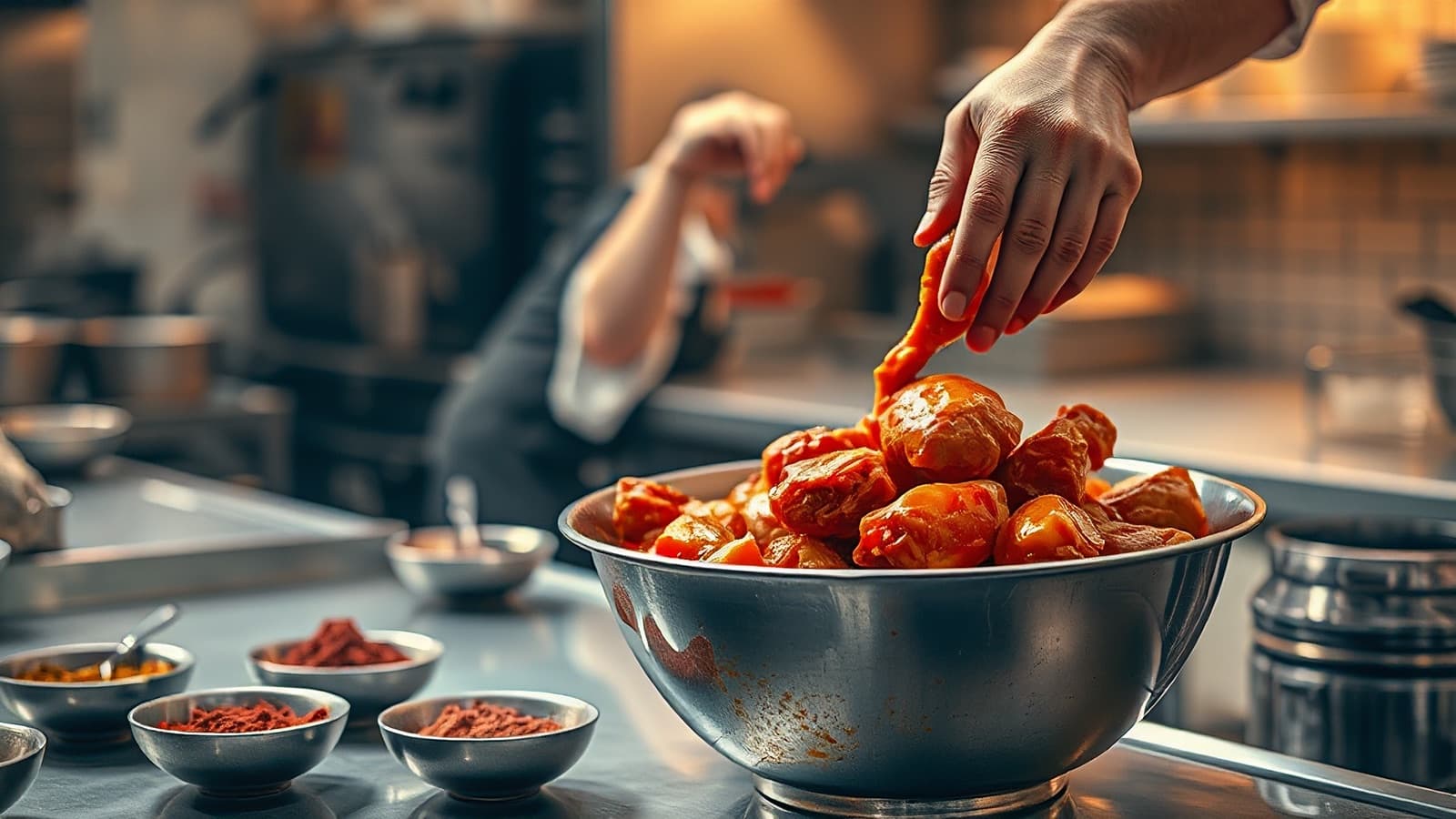
Every kitchen has had this argument. The marinade recipe hasn't changed in years, the same cook made it, and yet Tuesday's tandoori came off the grill juicy and even, while Friday's was patchy, one tray oddly mushy at the edges. Nobody changed anything — so why did the plate change?
The answer starts with an uncomfortable piece of food science: a marinade does far less than most kitchens assume, and the little it does is extremely sensitive to how it's handled. Understand what a marinade actually does, and the fix at scale becomes obvious.
A marinade is mostly a brine
Here is the finding that reorganises everything: a marinade does not soak flavour deep into meat. In controlled testing, most marinade ingredients never penetrate past the first millimetre. Sugar, pepper, cumin, garlic, even oil — all of it stays on the surface. The interior of a marinated piece of chicken tastes, for the most part, of exactly one thing: salt.
Salt is the exception because it is a small, charged molecule that moves through muscle tissue where larger flavour molecules can't. As it does, it partly dissolves the proteins that make muscle contract, so the meat holds on to more water during cooking. That is the real prize of marinating — not flavour injection, but moisture retention. The seasoning and char you taste are a surface event, built during cooking as sugars caramelise and aromatics hit heat.
This is why time in the marinade matters in a specific way. The brining effect builds over a window — roughly one to eight hours for poultry and red meat — and then stops paying off. Marinate too briefly and the salt never does its work; the meat cooks up drier and blander. There is a right amount of time, and it is neither "a quick dip" nor "however long it sat there."
The tenderiser is a loaded gun
Then there are the ingredients kitchens reach for to make meat tender: acids like lemon or yoghurt, bases like baking soda, and enzymes from raw pineapple, papaya or ginger. These genuinely work — and every one of them can ruin a batch.
They all change texture, but with sharply different costs. In controlled tests, chicken marinated in raw pineapple turned fall-apart tender but lost roughly a third of its weight in water and came out mushy and pasty at the surface. A lemon-style acid gave milder tenderising but a slightly squeaky texture and heavy moisture loss. A baking-soda brine held on to the most water — losing only a twentieth of its weight — but tips into a metallic, ammoniac taste the moment the concentration runs high.
The difference between a tenderiser that works and one that wrecks the plate is not the ingredient. It is the concentration and the time — the two things a busy kitchen controls least.
That is the trap. These are not forgiving ingredients with a wide margin. They have a narrow band where they help and a cliff on either side, and both edges of that cliff — concentration and contact time — are exactly what drifts when a kitchen is under pressure.
At scale, the enemy is variance
Now put this science into a kitchen doing five hundred covers. The marinade gets mixed by whoever is on prep, by eye, from memory. One day the acid is heavier, the next the salt is light. A tray goes in at the start of service and comes out four hours later; an identical tray gets pulled after forty minutes because the section ran short. The walk-in is full, so one batch marinates warm on the counter — now it's not just inconsistent, it's a food-safety question.
None of these are recipe failures. The recipe was fine. What failed is that a marinade's active levers — salt concentration, acid and enzyme strength, contact time, temperature — are precisely the variables a high-volume kitchen cannot hold steady by hand across every shift and every cook. The science that makes marinating work is the same science that makes it inconsistent the moment it's done informally at volume.
Seen this way, the problem isn't "find a better marinade." It's "remove the variance." A marinade formulated to a fixed specification — salt, acid and any enzyme balanced and held at a known concentration — takes the two most dangerous variables off the prep bench. The cook is no longer rebuilding the chemistry from memory every morning; they're applying a known quantity, the same way every shift.
This is why a pre-standardised marinade — mixed to a fixed specification and held at a known salt, acid and enzyme concentration — behaves so differently at volume. It isn't a cleverer recipe; it's the same chemistry with the two most dangerous variables taken off the bench before a single tray is filled. The cook stops rebuilding the formula from memory each morning and starts applying a known quantity, identically every shift.
That unglamorous kind of consistency is most of what we think about at Kaflur. But the route matters less than the principle: whether you get there with a standardised marinade, tighter prep discipline, or a written spec every cook follows to the gram, the food science points the same way. At scale, the recipe was rarely what failed you. The variance was.