
Why moisture content doesn't tell you how a dehydrated vegetable will cook
Two dehydrated vegetables can carry the same moisture percentage on the spec sheet and still behave nothing alike in a pot of boiling water. The number that actually predicts kitchen performance sits one line further down.
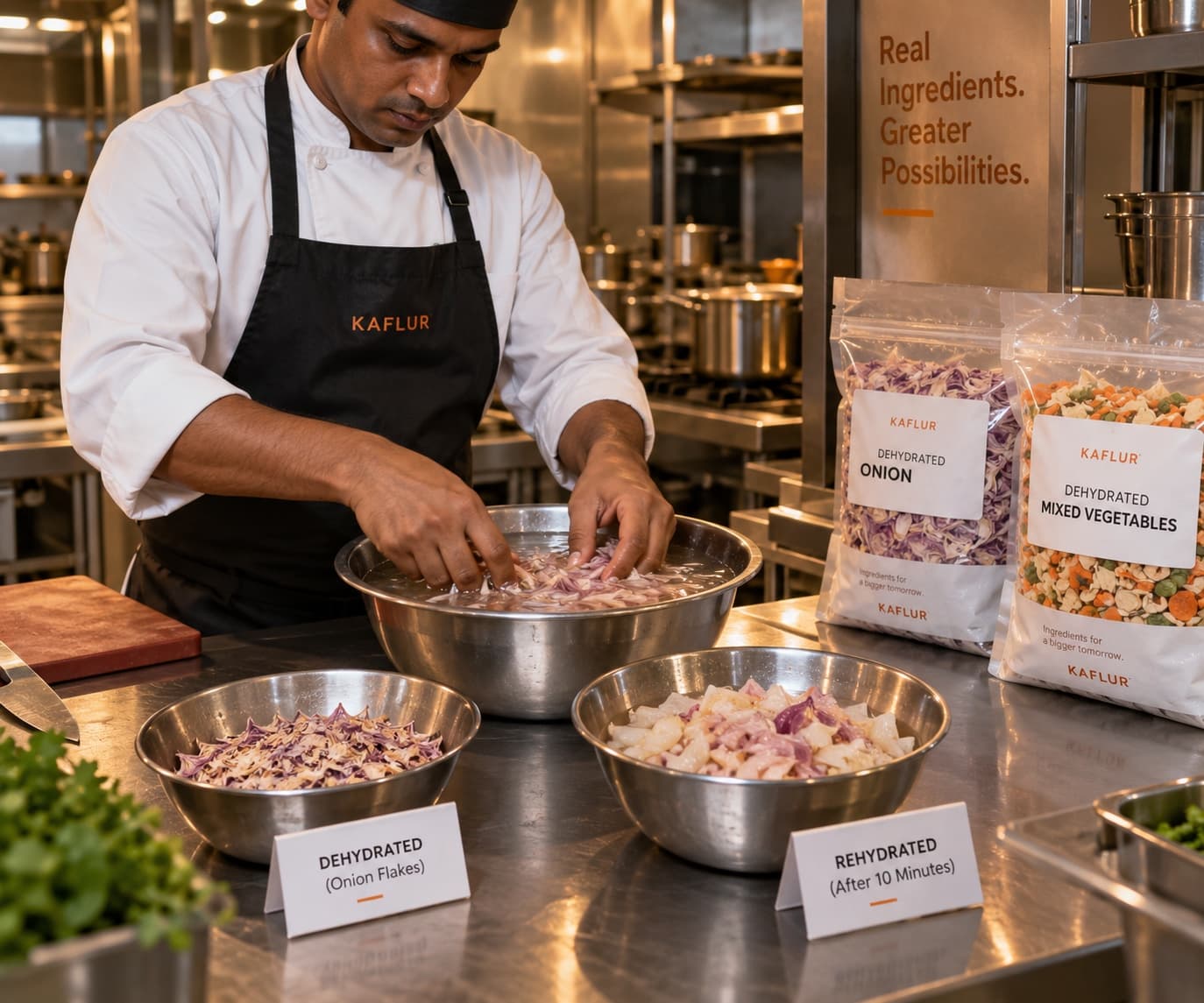
A buyer switches dehydrated onion suppliers, matches the moisture spec to the kilo-decimal — same percentage, same certificate of analysis — and the new batch still softens slower, holds its shape oddly, and tastes flatter once it's back in the gravy. Nothing on the paperwork explains it. The moisture number was right. It just wasn't the number that governs how the product behaves once water goes back in.
Moisture content answers one question: will this survive on a shelf without spoiling. It says almost nothing about how the vegetable performs once a chef adds water back — and that second question is the one that actually determines whether a dehydrated ingredient is usable at scale.
Moisture content is a stability spec, not a cooking spec
Dehydrated vegetables sold into the Indian export and bulk market typically carry a moisture content in the 3–8 percent range, with water activity held below 0.6 — the threshold below which most spoilage organisms can't grow. That number is what a quality-control lab checks first, and it's the right thing to check first, because it's the difference between a product that holds for months in a drum and one that doesn't. But two batches can hit an identical moisture reading by completely different routes — one hot-air dried for hours at high temperature, one vacuum- or freeze-dried at a fraction of that thermal load — and arrive at the same percentage with very different internal structure. Moisture content tells you the product is stable. It doesn't tell you what's left of the cell structure that has to reabsorb water when a chef rehydrates it.
The number that actually predicts kitchen behaviour: rehydration ratio
Rehydration ratio — how much water and volume a dried product reclaims when soaked or cooked, and how close it gets back to something resembling the fresh vegetable — is the spec that correlates with how a dehydrated ingredient actually performs in a recipe. It's driven by drying method, not by the final moisture number. Hot-air drying works by driving moisture out through heat over an extended period, which collapses the cell walls and closes the capillary pores the vegetable needs to draw water back in; comparative studies on garlic slices found vacuum- and freeze-dried product rehydrating markedly better than hot-air-dried product for exactly this reason — the internal architecture that would reabsorb water is still intact. A published comparison of drying methods on broccoli and carrots found air-drying degraded vitamin C by roughly 66 percent against a 5 percent loss under a gentler method, and left the structure measurably less able to reclaim its original volume in water. None of that shows up on a moisture certificate. It shows up when the chef opens the bag.
A moisture certificate tells you the product will survive the shelf. It says nothing about whether it survives the pot.
This is also why a drying method that looks slower or costlier on paper can be the cheaper choice at the point of use. A hot-air-dried vegetable that rehydrates to 70 percent of its original bulk means a kitchen has to over-dose the recipe to hit the same finished weight and texture a better-rehydrating batch would deliver at spec — the saving on the input price gets spent back, invisibly, in extra grams per batch.
Particle size is the third variable, and it's the one buyers specify least
Cut size and particle size change drying speed and rehydration evenness independently of both moisture and method. Smaller, more uniform pieces dry faster and more predictably because there's more surface area relative to volume, which shortens the time the vegetable spends exposed to heat — and shorter exposure means less of the vitamin and colour loss that comes with prolonged thermal drying. Irregular or inconsistent piece sizes in the same batch dry unevenly: the smaller pieces are done and starting to degrade while the larger ones are still holding excess moisture, and that spread shows up later as clumping or patchy rehydration in the finished dish. For a manufacturing line dosing a fixed weight of dehydrated vegetable per batch, an unspecified or inconsistent cut size is as much a variability risk as the moisture number — it just doesn't appear on the certificate of analysis the way moisture does.
None of this argues for chasing the gentlest, most expensive drying method for every ingredient. A base-layer onion going into a simmered gravy that already runs 20 minutes of moist heat has far more forgiveness for a hot-air-dried input than a delicate leafy vegetable meant to rehydrate quickly for a quick-serve bowl — matching drying method to how the ingredient is actually used downstream is the real specification exercise, not defaulting to the best number on the sheet.
This is the part of dehydrate manufacturing Kaflur treats as a specification, not an afterthought: fixing drying method, particle size and rehydration ratio against how a customer's kitchen or production line will actually use the product, and validating rehydration performance before a format goes to volume — rather than leaving moisture content to stand in for a quality picture it was never built to describe. If a dehydrated ingredient in your supply chain has been inconsistent in ways the spec sheet can't explain, that's worth a conversation before the next contract is signed.