
Why the last scoop of a seasoning blend never matches the first
A seasoning blend that passes every uniformity check at the mixer can still arrive at the kitchen tasting different scoop to scoop — because the unmixing happens after the test, not during it.
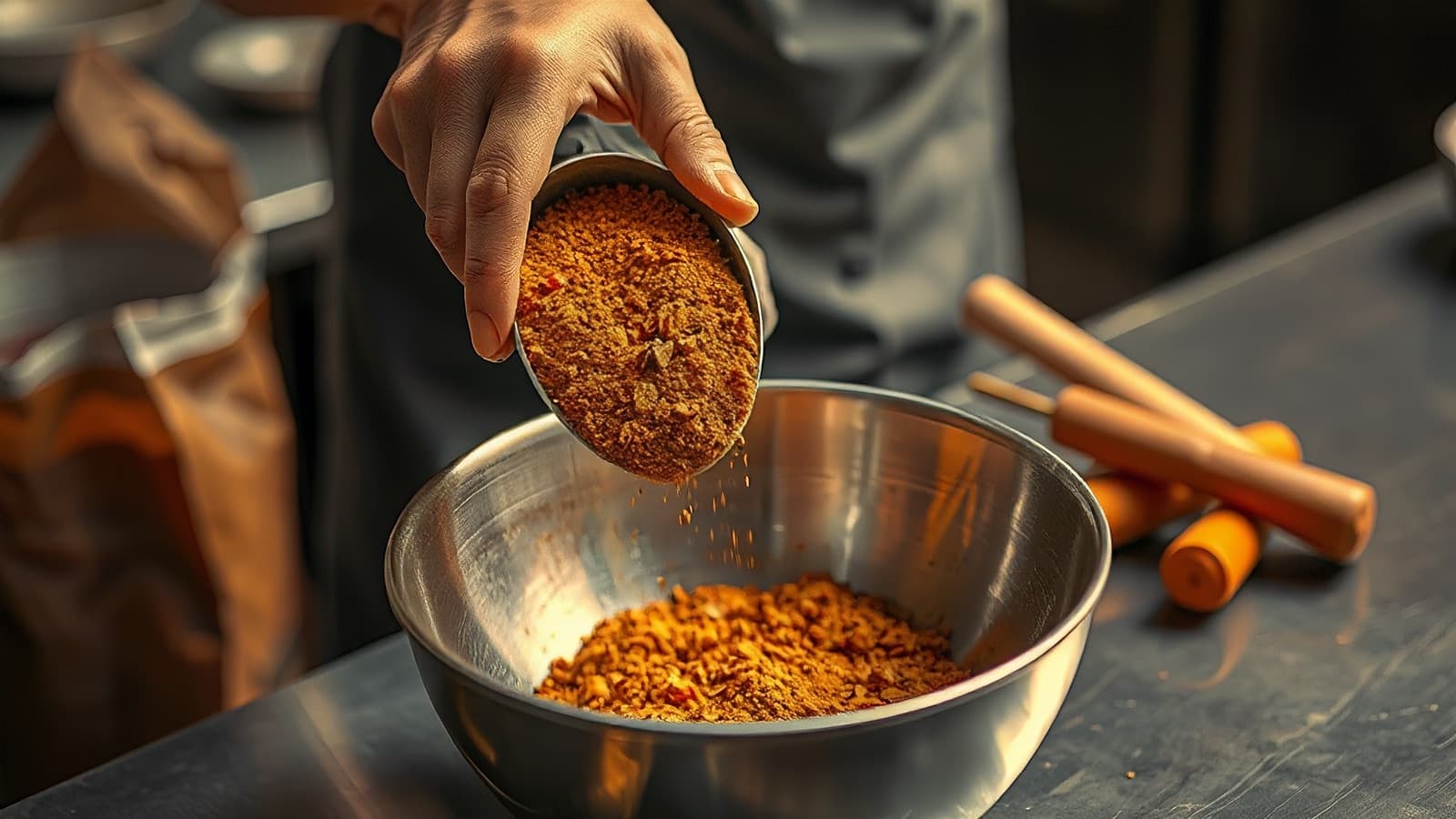
A chef opens a fresh sack of tandoori seasoning on a Monday and it tastes exactly as specified — the right heat, the salt balanced, chilli and kasuri methi in the proportion the sample jar promised. By Thursday, the same bag, scooped from near the bottom, tastes flatter — saltier in one batch, weaker in the next. Nobody changed the recipe. Nobody changed the supplier. The batch record even says the blend passed uniformity testing before it left the plant.
That last fact is the part worth sitting with. The blend really was uniform — inside the mixer, at the moment it was tested. What happened afterwards is a separate problem, and it isn't a quality-control failure so much as the predictable outcome of physics that most kitchens, and a fair number of manufacturers, never account for.
Uniform in the mixer is not the same claim as uniform in the bag
A powder blend is tested one way: samples are pulled from the mixing vessel, usually with a thief probe, while everything is still suspended together. That test answers one question — can this equipment achieve a homogeneous mix — and it answers it honestly. It does not answer a second, separate question: does that mix survive being discharged from the mixer, dropped into a hopper, run down a chute, poured into a bag, stacked on a pallet, and trucked to a kitchen. Those are five separate opportunities for a blend that tested perfectly to quietly come apart, and none of them happen inside the mixer where the test was taken.
This is the gap between blend uniformity and segregation, and it's well documented across food, pharmaceutical and nutraceutical powder-handling practice: a blend can show excellent uniformity at the point of test and still ship a bag where the top and the bottom are measurably different in composition. The kitchen only ever sees what comes out of the bag — never what sat in the mixer.
The physics doing the unmixing
Segregation isn't random drift. It has named mechanisms, and a seasoning blend is a near-ideal candidate for several of them at once, because it typically combines components with very different particle sizes and densities in the same bag — fine chilli powder, a coarser roasted-cumin grind, salt crystals, dehydrated garlic flakes.
Sifting, or percolation, is the dominant mechanism: small particles fall through the gaps between larger ones every time the blend is jostled, so fines migrate down and coarse particles rise — precisely the pattern a scoop from the top versus the bottom of a bag would reveal. Trajectory segregation adds to it during any free fall, such as pouring into a bag or hopper, where heavier, coarser particles travel further before landing than fine ones do, spreading the blend into rings rather than a uniform cone. A widely used rule of thumb in powder engineering holds that a size ratio greater than roughly 3:1 between the largest and smallest particles in a blend is enough on its own to drive meaningful segregation — and a seasoning blend combining ground spice with salt crystals or flaked garlic clears that ratio without trying.
A blend that tests uniform in the mixer and separates on the way to the kitchen hasn't failed quality control. It has skipped a step quality control was never designed to catch.
What formulation fixes, and what handling can only manage
The instinct is to treat this as a packing or logistics problem — ship in smaller bags, tell the kitchen to shake before use, add a mixing step at the point of use. These help, marginally, but they work against the physics rather than with it, and they put the fix in the one place with the least control over particle size: the kitchen at the point of use.
The more durable fix happens upstream, in formulation. Matching particle size distribution across a blend's components — grinding the coarse elements down or granulating the fine ones up so no ingredient sits wildly outside the range of the others — removes the size differential that sifting exploits in the first place. Where a genuine size gap can't be avoided, agglomeration binds the fine, migration-prone particles onto a carrier particle so they move as one unit instead of independently. Both are decisions made at the recipe and process stage, months before a bag reaches a kitchen, and both are far cheaper to get right in development than to firefight after a client complains that some batches run hotter than others.
Where this sits in a Kaflur specification
This is precisely why particle-size matching is built into how Kaflur develops a seasoning or dry-mix formula, rather than bolted on after a recipe is finalised — a blend engineered so the last scoop out of a bag tastes like the first isn't a packaging promise, it's a formulation one. If your current seasoning supplier can't tell you what particle-size range each ingredient in your blend was milled to, that's worth asking before the next round of "some batches taste different" complaints, not after. Happy to walk through what that specification looks like for a blend you're already running.