
Costing a private-label gravy, line by line
Most first cost sheets for a private-label gravy carry four lines. A production run carries around ten. The six that go missing are missing for one reason, and it is the same reason every time.
"Ingredients come to this much a kilogram. The pouch and the closure come to this much. We have put something in for labour and something for processing, and at our shelf price the margin works."
That sheet arrives most weeks, four rows and a total. The arithmetic in it is correct. What makes it unreliable is that a production run incurs around ten costs and a sheet built that way can see four of them.
The six that go missing are not obscure, and nobody is hiding them. They go missing because of the unit it is written in. A founder's cost sheet is written in rupees per kilogram, because that is the only unit a kitchen needs: you buy ingredients by weight and you sell portions by weight. A run does not work that way. Six of its costs are charged per changeover, per batch, per design, per case or per pallet per month, and a sheet with one column has nowhere to put them.
The four that scale with volume
Ingredients, at formula percentages rather than recipe quantities. Primary pack: the pouch, the laminate it is made from and whatever closes it. Direct labour. Conversion, meaning the processing itself.
These are the easy four because they are close to linear. Double the volume and they roughly double. That is why they get written down, and why a sheet holding only them reads as finished.
The six that are not
Changeover. Charged once per changeover, whatever you run afterwards. What actually sets a co-packer's MOQ publishes the arithmetic and what is negotiable in it. Here it is one line, and it does not get smaller when your order does.
Yield loss and flush. Charged per batch and per start-up. Product sits in the vessel and the pipework and does not come out. The first material through the filler is not to specification and nor is the last. Between products there is a flush, and what the flush pushes out is paid for.
Fill weight is the part founders have usually never costed. Average-weight rules work on the sample average meeting or exceeding the declared weight, so a filler is set to aim above the label figure rather than at it. One checkweigher supplier puts the consequence plainly: fill five per cent over and one pack in twenty is given away free. Published fill-control cases have brought giveaway from 0.69 per cent down to 0.14 per cent. That is not a promise about your line. It is evidence that the figure is a measurement, and worth taking.
QC and retained samples. Charged per batch and per date code. Release testing is the obvious half. The retention is the half that surprises people.
One large retailer's supplier quality standard asks for a minimum of three samples per batch or date code, held for the shelf life plus a margin, its own worked example being a twelve-month product retained for thirteen months. Apply that to a gravy sold at twelve months ambient. Three units of every code you run get made, filled, retorted and packed, and are never invoiced, because they sit in a cupboard for more than a year so that a complaint arriving in month ten can be answered with the product rather than with a recollection of it.
Artwork, plates and per-market label compliance. Charged per design, then again per market.
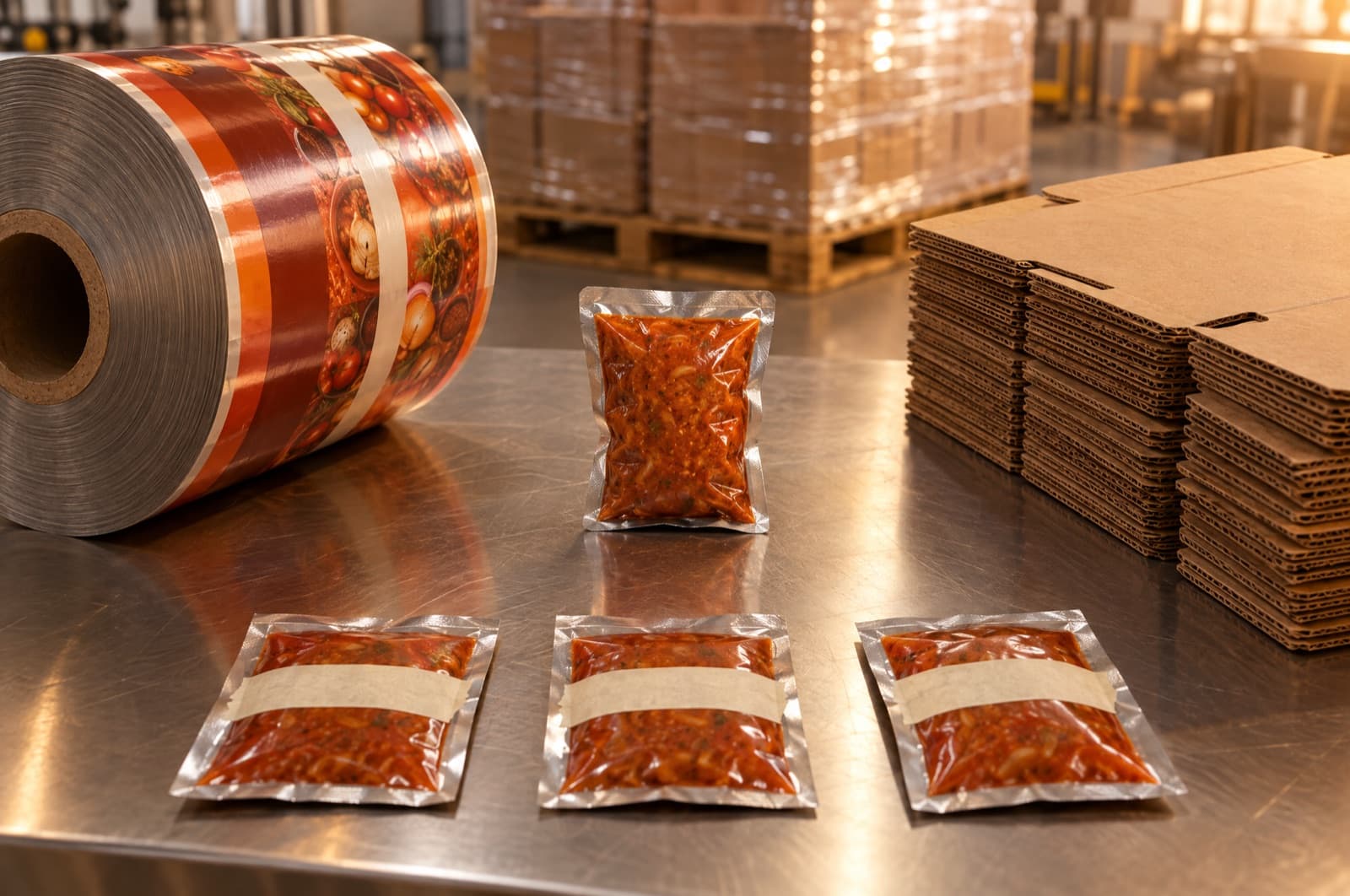
Rotogravure cylinders are engraved per colour per design, so a change to a panel is tooling rather than a file. The engraving is rarely what hurts. The minimum is. Printed rollstock is generally quoted from around 300 kg and premade gravure pouches from around 10,000 pieces, where digital printing will start at roughly 1,000, and one converter publishes lead times of seven to nine working days to make the cylinders and a further fifteen to twenty days to print. Change the panel late and you are not buying an amendment. You are buying the minimum again, and the calendar with it, which is the mechanism underneath the argument that a launch date is set in the first fortnight.
Compliance is then per market. The declarations required on a pack sold in India are not the ones required in the United States or the United Kingdom, so two markets is two artworks and two sets of tooling. That is decided at the sheet, not at the border.
Secondary packaging and palletisation. Charged per case and per pallet. The shipper, the inner, the tape, the case label, the stretch wrap, the pallet itself, and the labour to case-pack and wrap it. No single item here is large, which is exactly why none of them gets written down.
Warehousing. Charged per pallet per month, for as many months as the stock waits. Indian warehouse space is quoted by the square foot rather than by the pallet: one 2026 market guide gives an indicative ₹18 to ₹60 per square foot per month across cities and grades, and a standard pallet footprint is around 1.2 square metres, so floor area alone comes to a few hundred rupees a pallet a month before racking, handling or labour. Treat that as a model to run against real quotes. The input you are missing is not the rate anyway. It is your days of cover, and you have not decided that when you write the first version.
Every one of the six is charged in a unit the sheet has no column for.
Build it so it can be priced in one pass
Give the sheet six columns instead of one: per kilogram, per batch, per changeover, per design, per case, per pallet per month. Fill in what you know and leave the rest named and empty. A manufacturer can price an empty column. It cannot price a column that is not there, which is why a quote comes back carrying a number nobody can reconcile against the spreadsheet.
Then separate what can be quoted from what has to be measured. Materials and pack are quotable against a specification, and conversion can be priced once the process route, the batch size and the pack format are fixed. Changeover time, fill losses and holdup are measurements, and they come out of a pilot rather than out of a conversation. Carrying those at actuals is usually cheaper than carrying a guessed allowance that was wrong in either direction.
A margin quoted before conversion cost is known is a margin derived from four lines. The real cost of private label runs that argument and the walk-away test in full.
A first sheet cannot be complete, because some of its inputs do not exist until something has been made. It can be complete in its headings.
At Kaflur, private label work is quoted this way by default: materials against the specification, conversion priced once the route and the pack are set, and testing, trials and retained samples carried at actuals. Your spec, packed in your livery, for retail, food service or export. It makes for a less comfortable first number than a four-line sheet does, and it survives contact with a production run.
If you have a cost sheet and a shelf price and you are not sure which of the two is doing the work, that is a conversation worth having before anything is printed. kaflur.com