From idea to shelf, your launch date is set in the first fortnight
Development finishes roughly when everyone expects it to. What decides when you can actually sell is a handful of choices made at the start, most of which stop being reversible the moment artwork goes to print.
You have a launch date. It is in a deck, or it is in a conversation with a distributor who asked when they could expect stock, and it was chosen because it felt far enough away to be safe.
It is usually wrong by months. What is interesting is that the slip almost never comes from development running long. Bench work is the predictable part of this. The date moves because of decisions taken — or postponed — in the first fortnight, before anybody has tasted anything.
Three things get decided before there is a product
Pack format, process route and price point arrive together, whether you plan them or not. They are not independent variables, and changing any one of them moves the other two.
The process route is not a preference. A product's own chemistry and the pack it goes into decide how it has to be made safe to sit at ambient temperature, and that decision sets which line it runs on. Which line it runs on is most of the conversion cost — and most of the reason a shelf-stable pouch needs neither a fridge nor a preservative.
Fill weight sits underneath the price point, and fill weight changes the thermal process. A 200 g retail pack and a 1 kg catering pack of identical composition are not the same product to a production planner. The heat has further to travel in the larger one, and the time it takes is a cost.
Most briefs arrive with the pack already chosen, usually on how it will look on a shelf. That is the decision most likely to be reversed later, and it is the one that quietly sets the calendar.
Artwork is the point of no return
Up to the moment artwork is committed, changes cost you time. After it, they cost money you have already spent.
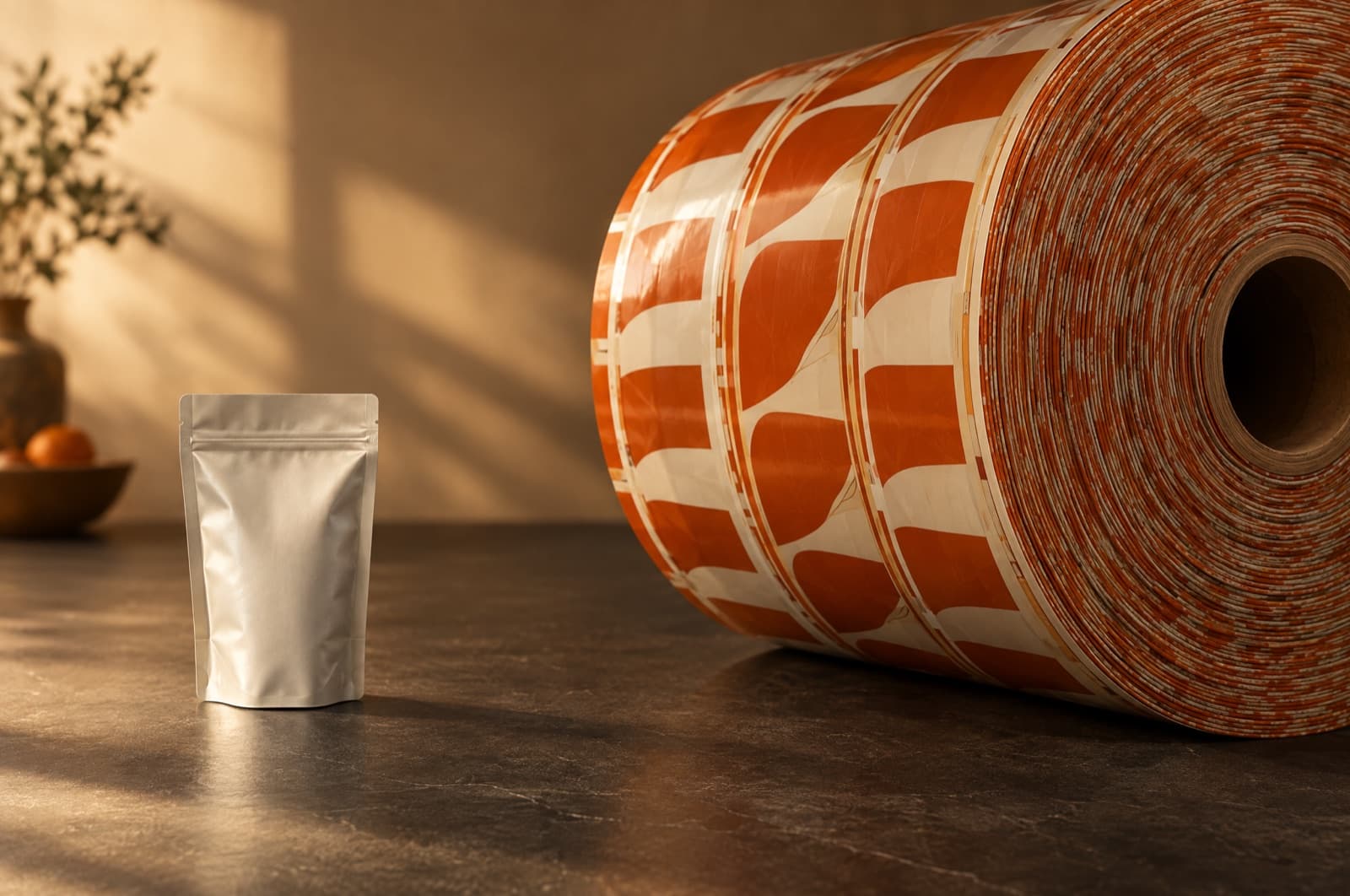
Flexible packaging is printed from engraved cylinders — a set per design, one for each colour. Change the artwork and the set is re-cut. Not adjusted; re-cut. That cost lands per design and it lands again every time the design moves, which is why a brand that prints before its formula is locked tends to print twice.
The label is not decorative either. Declared weight, the ingredient list in descending order, the nutrition panel and the allergen statement are all derived from the final formula. Alter the formula after printing and the pack in your warehouse is no longer accurate. You do not get to correct that with a sticker in most markets, and the markets you intend to sell into each have their own rules about what the panel must say and in what units.
Then there is everything the pack sits inside. Case count, carton dimensions and the pallet pattern follow from the primary pack, and distributors have opinions about all three.
Everything upstream of printed artwork costs time to change. Everything downstream costs money you have already spent.
This is the whole argument for buying a feasibility study before artwork rather than after. It is a small, unglamorous piece of work that exists to make the expensive decisions in the order that keeps them cheap.
The pilot batch is not the product
Custom development from a brief to a pilot batch with your label on it is a ten to twelve week piece of work. That is a real milestone and it deserves to be celebrated. It is also not a sellable product, and this is where founders get caught.
A pilot proves the formulation can be made on production equipment. It does not prove the product holds. Accelerated testing gives you an early indication of how it will age; real-time testing is the evidence, and it runs on its own clock, which starts when the formulation locks and not a day earlier. Change the formulation afterwards and the clock restarts. That programme is a subject of its own and we will come back to it.
So the honest position is this: your launch date is set by the longest irreversible chain, and almost everyone plans against the shortest one. Development ends in week twelve. If the shelf life you want to print is twelve months and the product is new, the evidence for that number arrives considerably later.
There is a version of this that works. Lock the formulation early and start the shelf-life clock the same week, even while sensory tuning continues on the margins. Hold artwork until the panel data is final. Treat the pack decision as an engineering input rather than a branding one, and make it with a measurement rather than a mood board. Pilot on material nobody is waiting for, which is a different thing from pilot on material you have already sold — a distinction that decides whether a first production run teaches you something or costs you a customer.
None of that shortens the work. It stops the work from happening twice.
And there is a decision underneath all of it about whether the product should be built this way at all, or licensed, or left as it is. We have written before about when a food brand should walk away from private label, and the same honesty applies here: a brief that cannot yet answer what the product is for does not need a development programme, it needs a fortnight of thinking.
At Kaflur we call this road Idea to Shelf. You bring the gap in the market; we engineer the product that fills it, prove it holds, and make it at volume with your label on it. Ten to twelve weeks. Brands start small and scale on the same line, and the formula, the brand and the customer relationship stay yours throughout.
If the product already exists and needs replicating rather than inventing, that road is shorter. If you would rather begin from a formulation already developed, shorter still. Three ways in, one partner — and moving between them is cheap, because they all end on the same line.
The first thing we do with a new brief is establish which of the decisions above are still open. The ones that are open are cheap. The ones that have quietly been made already are the ones worth examining before anything goes to print — kaflur.com.