
Glass, retort pouch or frozen: the choice is made by acidity
A jar looks better on a shelf than a pouch, so pack format usually gets chosen for how it will look. The product's pH decides whether that choice can actually work, and by the time anyone measures it, the packaging may already be ordered.
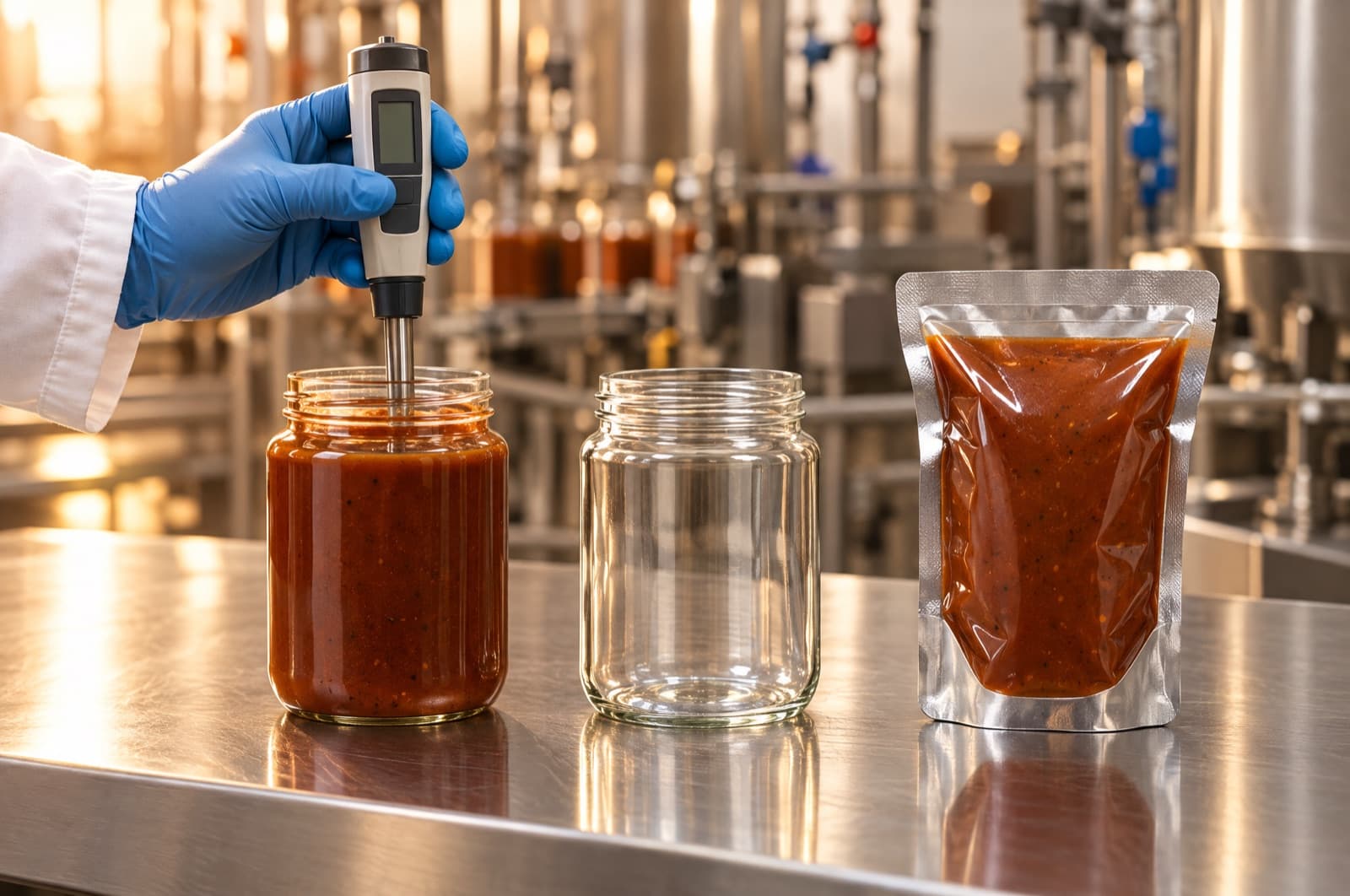
A founder builds the brand deck first: glass jar, a label that reads well on a shelf, a look that photographs like something worth paying more for. The gravy formula comes after, and its pH is never on that deck at all. By the time anyone measures it, usually when a co-packer asks, the packaging has often already been chosen, and sometimes already ordered.
That is the wrong order to make the decision in. The product's acidity decides what packaging is actually available. Not the other way round.
The line sits at pH 4.6
Food regulators everywhere draw the same line, inherited from decades of work on Clostridium botulinum: a food with a finished equilibrium pH above 4.6 is classed as low-acid, and a low-acid food packed in a sealed container has to reach commercial sterility through a full validated thermal process. In the US this sits in 21 CFR Part 113, and other markets mirror the same threshold under their own rules. At or below 4.6, the product's own acidity does most of the preservation work on its own, and a lighter process is enough to make it safe.
Most Indian gravies, curries and sauce bases built on dairy, coconut or a low-acid vegetable bulk sit above 4.6. A tomato-forward base, a pickle, most vinegar marinades and many chutneys sit at or below it. The two groups are not interchangeable, and the number is the only honest way to know which one is in front of you. Tasting sour is not the same as measuring 4.6, and a base that reads mild on the tongue can still test acidic enough to matter.
Below the line, hot fill into glass holds honestly
An acid or acidified product, at or below pH 4.6, can go through hot-fill-hold: heated to roughly 82–95°C, filled into the container at that temperature, held sealed for a set time, then cooled. The heat and the hold do the pasteurising; the acidity keeps anything that survives from growing afterwards. Run this way, glass is a genuinely good choice. It holds heat evenly through the hold step and takes a premium label well, and the process asks only one precaution of it: the jar needs pre-warming, typically to around 60°C, before hot product goes in. Skip that and the thermal shock of hot liquid meeting cold glass cracks jars on the line.
A pH of 4.6 decides more about a packaging line than any design brief does.
Above the line, glass and retort stop pairing well
A low-acid product needs the harder process: a full retort cycle, validated to reach a lethal temperature at the coldest point of the slowest-heating pack, running materially longer than hot-fill-hold. Glass can technically be retorted, and some plants do it, but the practical case against it stacks up fast. A retort load of glass jars needs a longer come-up time to reach temperature uniformity than the same load in pouches, roughly 28 minutes against 24 in published comparisons, because glass holds more thermal mass and conducts heat more slowly than a flexible pouch. Cooling has to be just as careful in reverse: incoming water can't strike the jars directly, and the cool-down has to stay gradual, or the same thermal shock that cracks jars on a hot-fill line cracks them coming out of a retort instead. A pouch flexes with the pressure differential through the cycle rather than fighting it, and its seal is a weld rather than a lid under torque, which is a large part of why it holds closure integrity through a cycle that is harder on the package than hot-fill-hold ever is.
None of that makes glass a bad material. It makes it a material suited to one process and not the other, and the process is chosen by the product's chemistry, not by which one looks better on a shelf.
Frozen is the third road, and it answers the acidity question by avoiding it: growth is arrested by temperature rather than chemistry, at the cost of a cold chain. Retort and frozen already have a full kitchen-economics comparison run against each other, and the frozen cost stack is priced in full separately. Worth reading before assuming frozen is the easy way out of a pH problem.
The honest limit
If a brand has already committed to glass and the formula sits above 4.6, one of the two has to change: the pack, or the product. Reformulating to bring the pH down changes flavour, and not every recipe can take that change without becoming a different dish. It rarely happens quietly this late. It happens after a batch is rejected, or a plant asks a question nobody wanted to answer once the artwork was already printed. The cheaper time to ask is before either is committed, not after.
Kaflur measures pH before quoting a pack format for exactly this reason: retort pouch, HDPE tub or hot-fill glass, chosen by what the formula actually is rather than what the brand deck assumed. If a formula's acidity and its intended packaging haven't been checked against each other yet, that is worth a conversation before the artwork goes to print.