
What a retort has to prove before it can run your product
A retort is never qualified on its own. What gets qualified is one product, in one pack, in one load pattern, in one vessel, and the proof runs to two studies and four commercial batches. Here is what gets measured, and what quietly cancels it.
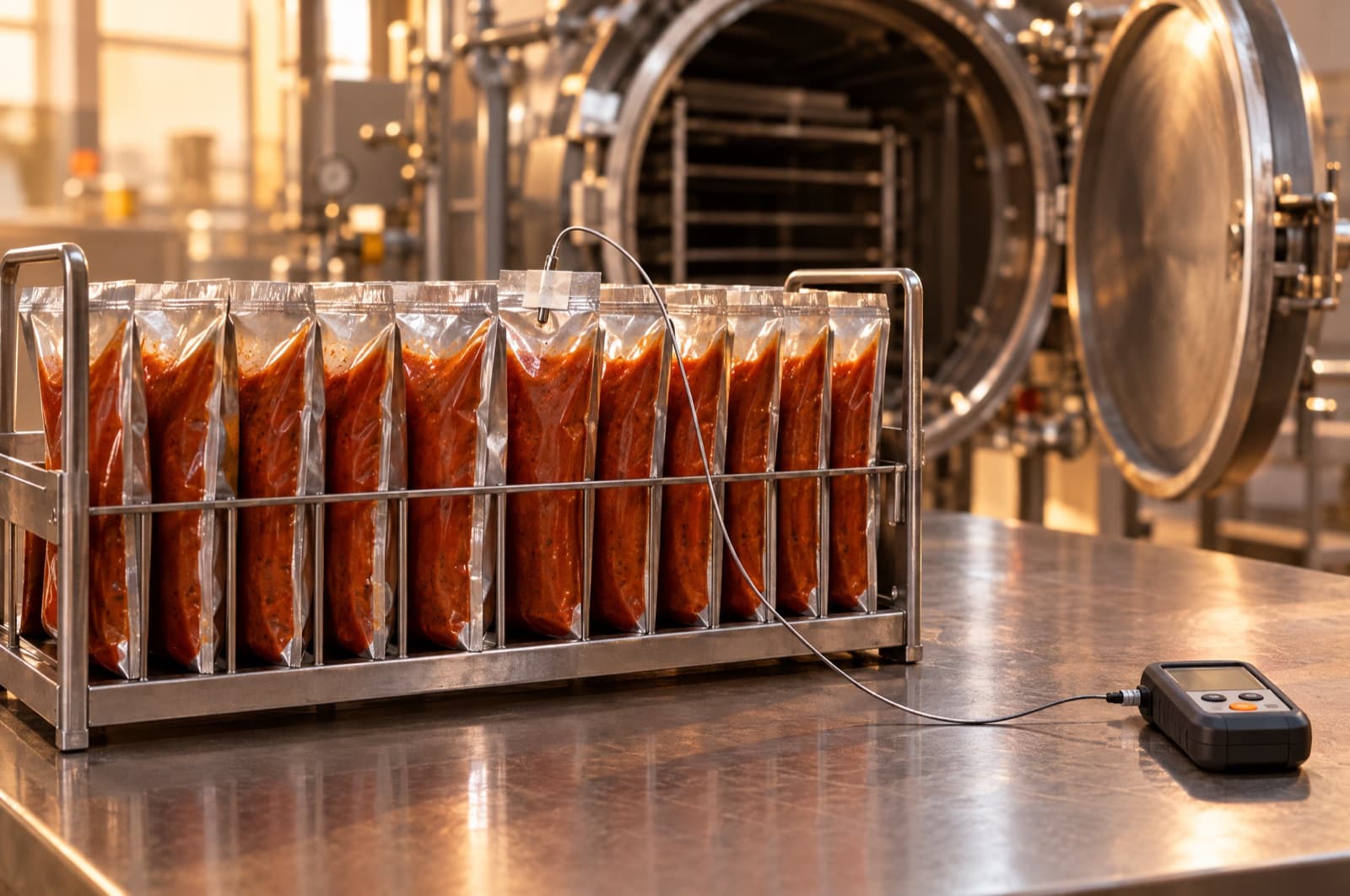
The formula is signed off, the pouch size is fixed, and the question you now want answered is when the first saleable batch can run. The answer is not a date. Before a retort can make food you are allowed to sell, it has to prove that a lethal process reached the coldest point of the slowest pack in the worst position in the load, and that proof belongs to your product rather than to the machine.
Why a retort pouch doesn't need a fridge or a preservative covers commercial sterility and the F0 figure the process has to clear. This is the other half: how that figure gets established for your gravy in your pouch, and the quiet ways it stops being true.
The empty vessel is measured first
Nothing goes near a heat penetration study until the retort itself has been mapped. A temperature distribution study finds where the vessel runs cold, and the definition is plain: the cold spot of a retort is the last area in it to reach the minimum process temperature during come-up.
Published guidance expects at least ten working thermocouples to be evaluated from each test run, and where a vessel cannot carry that many, the answer is more replicate runs rather than fewer probes.
The tolerance is tighter than most people expect. For still steam retorts, inspection guidance expects every thermocouple to read within 1°F of the processing temperature at the moment process timing begins. For water immersion, no more than a 2°F spread between the lowest and the highest. One degree Fahrenheit, across a vessel loaded with your stock.
That is why the venting and come-up procedure stops being a warm-up and becomes part of the process. The procedure that achieved distribution in the study is the procedure production has to use. And distribution is established per container type, per size, per shape, per racking system, per product, and per individual retort. Two identical vessels standing side by side are two sets of evidence, not one.
Then the slowest pack, in the worst position
Only once the vessel is known does your product go in, with probes in it.
The cold spot inside a pack is found rather than assumed, through a series of tests with the thermocouple junction placed at different positions, for each combination of product, package and process. Where it sits is not intuitive. In a conduction heating product with little headspace it sits near the geometric centre, more headspace moves it upwards, and a convection heating product in an upright container can run coldest near the bottom.
Then the study is deliberately stacked against itself. Fill weight is set no lower than the maximum declared on the schedule, with any excess recorded as percent overfill. Thickness is run at the maximum specified for the pack, because a thicker flexible pack heats more slowly at the cold spot.
How much more slowly is worth seeing. A published study of retort pouched curry took pouch thickness from 11 mm to 15 mm and watched the heating rate parameter rise from 7.4 minutes to 12.6 minutes. Four millimetres of pouch, and heat takes close to twice as long to get in. Nobody tastes that difference and no artwork shows it.
After the cold spot is located, the work is repeated: at least two full replications, and a third where the two disagree with each other.
The schedule belongs to one product, in one pack, in one load
A process schedule is not a setting on the retort. It is a description of the only conditions under which that setting is known to work.
What gets written down with it is a list of critical factors, and the list is longer than a founder expects. On the product side: formulation and ingredient weights, fill weight, solids content, consistency, the size and shape of the solids, rehydration of dried components, fill temperature. On the package side: type, size and dimensions, nesting, headspace, maximum thickness, orientation. On the process side: still or rotary, come-up time, racking, heating medium, agitation, rotation speed, overpressure.
The US regulation for low-acid foods in hermetically sealed containers makes the same point in one line, requiring that critical factors such as minimum headspace, consistency and maximum fill-in or drained weight be specified in the scheduled process itself.
Read that list again as a procurement document. Consistency is on it, so a starch substitution is a process question before it is a cost question. Rehydration is on it, so a change of dried onion supplier reaches further than the invoice. Fill weight is on it, so a filler running generous is working outside the conditions that were proved.
The same regulation asks for something easy to miss: the schedule has to provide for the range of variation that commercial production actually produces, naming seasonal and growing fluctuations, variety differences, supplier processes and reprocessing. The bad tomato season has to be inside the schedule when it is established, not discovered later.
It is a document, not a dial
The study does not finish the job either. Confirmation by incubation is expected to cover containers from the test trials plus containers from each of four or more actual commercial production runs, which means a schedule earns its status across a production history rather than in an afternoon. Records of how the process was established are permanently retained by the person or organisation that made the determination. If a critical factor drifts out of control, the affected product is assessed by a competent processing authority, not by whoever is on shift when the alarm goes.
None of this feels like progress while it is happening. It produces no saleable stock and no photographs.
It also sets a sequence you cannot reorder. Every number the qualification rests on is one you chose earlier: the pack, the fill weight, the viscosity, the particle size. Change one afterwards and you are repeating a study rather than amending a document, which is the mechanism underneath the argument that a launch date is set in the first fortnight.
At Kaflur, retort processing is handled on those terms. Distribution and penetration established for your formulation in your pack and your load pattern, the critical factors written down where a buyer can be shown them, and the schedule treated as evidence rather than as a dial somebody turns. What comes out is shelf-stable without a cold chain, ambient for months, with freshness held by food science rather than by added chemicals.
If you are choosing a pouch size and a fill weight this month, those two numbers decide what has to be proved later and how often it has to be proved again. Worth a conversation before they are fixed. kaflur.com